Friday, June 19, 2009

The Gospel & the Zodiac

Scott Rassbach of the AJC gave a lecture on the Gospel and the Zodiac (based on the Unitarian minister Bill Darlison's book of the same name) as part of the AJC's Conclave 2009. A video of this lecture has been uploaded to Youtube, which you can watch in four parts below:


Another video of an interview with Bill Darlison himself (note that this interview was done before the book's release, and thus it is now widely available for purchase).


Finally, check out the book itself (my review of which should be in #2 of The Gnostic):


Wednesday, April 22, 2009

Whoever is Free is a Slave...

"Whoever knows the truth is free, and a free person does not sin, for 'one who sins is a slave of sin....' Those who do not allow themselves to sin the world calls free. They do not allow themselves to sin, and the knowledge of the truth lifts them up - that is, it makes them free and superior to all. But 'love builds up'. Whoever is free through knowledge is a slave because of love for those who do not yet have freedom of gnosis. Gnosis enables them to be free."

- Gospel of Philip (via Jeremy Puma's column in The Gnostic #1)

Monday, April 20, 2009

The Gnostic #1 Now Available

From Andrew Phillip Smith's blog:


"The Gnostic #1 is finally available.

It includes an interview with John Turner, an expert on Sethian Gnosticism, a new translation of the Gospel of Judas, a whirlwind tour of the alternative Judas, and a note on translational issues in the Gospel of Thomas. Gnostic-influenced writers are featured heavily with a long interview with Alan Moore, and an excerpt from a prose work inspired by William Blake, and articles on William Burroughs and Philip K. Dick. The more adventurous scholarly articles include Will Parker’s examination of the magical worldview, a look at the figure of Judas outside of the New Testament, and an examination of Paul’s attitude to Moses. Jeremy Puma’s regular column looks at the pivotal topic of Gnosis itself. Plus reviews of more than a dozen books. Oh, and an excerpt from Freke and Gandy's Gospel of the Second Coming. And more.

Scott Finch, John Coulthart and Eddie Campbell provide visuals.

The easiest way to purchase it is through Amazon:

http://www.amazon.com/exec/obidos/ASIN/1906834024/thegospeoftho-20

It's also available through amazon.co.uk, most other online bookstores and eventually in selected brick-and-mortar bookstores. Comp copies are on their way to contributors.

Thanks to you all for your encouragement and help."

Wednesday, February 18, 2009

Knowledge of God

If God is beyond the grasp of our fragile minds, then we have to content ourselves with the fact that our approximations of what God is are merely that - approximations. This should not, however, discourage us from using mythology, religion, and art as an attempt to describe and understand the majesty of God, however ultimately futile such an attempt might be, nor discourage us to use our heart and our Gnosis to come to the only real knowledge of God that can be attained.

Monday, February 16, 2009

Book Review: The Gnostics

Gnosticism has become increasingly popular over recent years, with the publication of the Nag Hammadi library, the even more recent Gospel of Judas, the blockbuster Matrix films, and, of course, the infamous Da Vinci Code book and film, not to mention countless others that slip under the radar of all but those who have “eyes to see”. However, all this popularity has led to a very skewed understanding of what Gnosticism is all about – some people think it was invented by Aleister Crowley, that it was all about Jesus' relationship with Mary Magdalene, or that it was a single obscure heretical group that didn't last very long. The Gnostics, by Andrew Phillip Smith, is an accessible book that dispels these erroneous views with a thorough introduction to the history, tradition, scriptures, and influence of Gnosticism in all its facets.

The book, numbering just under 250 pages, is broad in scope, dealing with nearly all of the Gnostic groups of note from its inception two millenia ago to its revival in modern days in both an occult and ecclesiastical form. Entire chapters are devoted to the Sethians and Valentinians, the Manichaens, the Cathars, and the Mandaens, with brief mention of other smaller groups (which we sadly lack information on) in between. Other chapters deal with Gnostic mythology, psychology, praxis, and, of course, that illusive concept of
Gnosis itself. Smith includes a rather sizeable chapter on the modern Gnostic revival which “brings it home”, as it were, in a way that people can relate to; works from Blake, Philip Pullman, Philip K. Dick, and other modern works are mentioned, allowing the reader to see how the transmission of Gnosis never truly died out. References, a good bibliography, and an index are also supplied, which will please anyone looking at this from an academic perspective.

It is evident that Smith is not merely a scholar in this field, but immensely interested in the traditions and texts which he studies. His enthusiasm is apparent in nearly every page of the book, and his sympathy for Gnosticism is a welcome change for Gnostics like myself, who all too often have to contend with the cruel eye of heresiological bias. However, in stating this, Smith never abandons historical accuracy or conventional scholarly practice in presenting his views. His arguments are generally solid and widely accepted throughout the academic world. One such argument is “Gnosticism is dualist”, which frequently raises the ire of modern Gnostics who vehemently disagree with the notion. Initially a Gnostic reader might bite their lip when reading this same argument coming from Smith, but it quickly becomes apparent that he has found a balance between the conventional view and the modern Gnostic one: “...classical Gnostic dualism was a dualism within unity.” Smith also takes care not to lump every Gnostic group into the same “dualistic” heading: “There is a clear distinction between absolute or radical dualism [...] and mitigated or moderate dualism, which posits a good God or good force at the beginning and culmination, at the highest point of the universe, but which acknowledges that an independent evil force or lower God has as much, or more, influence on our present world. The Sethians and Valentinians were mitigated dualists, the Manichaens absolute dualists.” While many modern (Valentinian) Gnostics might still grind their teeth at the word “dualist” being used here at all, this explict distinction between absolute and mitigated forms, so well described by Smith, goes a long way to ammending the somewhat negative usage of the word.

The Gnostics
is one of the few introductory texts that covers almost the entire scope of Gnosticism, providing a true and accurate portrayal of the variety and uniqueness that comes with Gnosis through the ages. In these days when people are questioning the orthodox Christian viewpoint, hungry now for a tradition that utilises the mythology they are used to in a radically different and positive way, it is important that they educate themselves on these alternate traditions that have remained a secret for too long in this world. In light of this, this book is one of the few I would recommend to those who know little or nothing about Gnosticism, and yet even for those who actively engage in the Gnostic path, for, as Smith puts it, “the opportunities for Gnosis are greater now than they may have been for several centuries.”

The Gnostics
, by Andrew Phillip Smith; Watkins Publishing (2008)

Wednesday, January 28, 2009

A Prayer for the Global Economy

We send energy to aid in the regeneration of the global economy, that we might all be prosperous, that we might all avail of wealth, and that we might all return to days of hope and joy, and partake in a better, more affluent world. We will for reinvigoration, recovery, and stimulation in the global economy, and we take the fear and gloom and despair that permeates the world and transform it into hope, joy, and universal happiness, for such such is the power and potency in us as global alchemists to bring about change and transformation, to ensure a thriving and flourishing economy for this day and the many days to come.

Wednesday, January 21, 2009

Wasatch Gnostic Society - 2009 Tolkien Lectures

The Lord of the Rings, while perhaps not intended as a Gnostic work, is a piece of fiction that tends to resonate loudly with Gnostics around the world - so much so that the Ecclesia Gnostica has a section dedicated to Tolkien on its website.

Recently when checking a fan-site (theOneRing.net) I found an interesting series of lectures being held by the Wasatch Gnostic Society. Details can be found here.

Thursday, January 08, 2009

My Views on Fate

I believe that certain things are "fated" to be, but, in fact, they're also completely changeable. In a normal human sense they are fated, but in a more "godly" sense they are changeable. This is where the distinction between Higher and Lower Self is needed. The Higher Self chooses, while the Lower Self enacts a choice. Indeed, this is where, to give an analogy from the Matrix, the Oracle tells Neo "You've already made the choice. Now you have to understand it". If we will, we may change anything that is "fated", but only through the Higher Self - and we may decide not to change something after initially trying to once we realise it was an essential choice for our spiritual growth.

Friday, September 19, 2008

Religion without a Goddess...

"A religion without a goddess is halfway to atheism."

- Dion Fortune

Thursday, September 11, 2008

The Demiurge's Laugh

The Demiurge's Laugh

It was far in the sameness of the wood;
I was running with joy on the Demon’s trail,
Though I knew what I hunted was no true god.
It was just as the light was beginning to fail
That I suddenly heard—all I needed to hear:
It has lasted me many and many a year.

The sound was behind me instead of before,
A sleepy sound, but mocking half,
As of one who utterly couldn’t care.
The Demon arose from his wallow to laugh,
Brushing the dirt from his eye as he went;
And well I knew what the Demon meant.

I shall not forget how his laugh rang out.
I felt as a fool to have been so caught,
And checked my steps to make pretense
It was something among the leaves I sought
(Though doubtful whether he stayed to see).
Thereafter I sat me against a tree.

- Robert Frost

Tuesday, September 09, 2008

Gnosticism as Playful and Celebratory...

"Another aspect of Rosicrucianism which few writers have touched upon, but which I feel is important, is its quality of playfulness, something that is arguably present in the Gnostic tradition that so influenced Rosicrucianism. The dualistic universe of the Gnostics, with its demiurge who created the physical world, need not be gloomy and depressing. Rather, it opens up the possibility of seeing the world as a marvellous conjuring trick, with the demiurge as the conjurer, whose skill is admired and applauded. But sooner or later the show will end and you must leave the theatre. From this viewpoint, Gnosticism ceases to be a negative, melancholy view and becomes instead a playful, celebratory one."

- Christopher McIntosh, The Rosicrucians

Wednesday, September 03, 2008

"The Gnostics" by Andrew Phillip Smith


Andrew Phillip Smith, who is a well known author within the Gnostic community, has just released a new book entitled "The Gnostics", which is an introductory text on the subject, numbering just over 250 pages. It looks like a very intriguing book, with a solid scholarly backing, and I will be posting a review of it here on Henosis Decanus soon.

In the mean time, you can order it here, or, if you want the slightly different cover of the American version, try here (although you'll have to wait 'til early October for that version). Also check your local bookshops.

Thursday, August 28, 2008

Blog List Updated

I've finally gotten round to updating my blog list with the better blog feed that Blogger has introduced (where you can see updates and click straight into the latest post of each blogger). I've also added a few new blogs and removed a few old ones. The two I'd like to highlight are:


This is run by a team from the Palm Tree Garden, and has some excellent posts thus far.


This is run by a friend, who has written a number of books on Gnosticism, and is the Editor of the new The Gnostic magazine, which should be out by the end of the year. I'll keep you posted.

I'll be attempting to update this blog a little more regularly, but in the mean time, feel free to check out my other blog:

Tuesday, August 26, 2008

"The Sunlight And Air Of The True Spirit"

"[Roiscrucianism] did develop a coherent teaching, which represented a highly interesting late revival of a Gnostic way of thinking. By "Gnostic" I mean, in essence, the view that the human spirit is trapped, as it were, under water, living a kind of half-life, ignorant of the fact that the sunlight and air of the true spirit are overhead. If knowledge (or gnosis) can make people aware of this, they will make the effort to swim upward and be reunited with their real element."

- Christopher McIntosh, The Rosicrucians

Sunday, August 17, 2008

Poetry: Doubters Of Divinity

You doubters of divinity -
You see devils in the hearts of all God's people,
Who must, by your great will, come out in straw
With pitchforks ready
To clash, steel on wood, against the sceptres of sure Science,
Held aloft upon the horses of your reign.
If only it were simple,
Adam cast across the rift from Atoms,
An uncrossable Abyss,
A mental chasm where only malice lies.
But where is subtlety in these uncertain times,
Where we, in our doubt, assume we know it all?
There is only red and blue and yellow,
Stark around their corners
Where no meld of hue is seen,
Nor permitted, nor encouraged,
As was once the case
When the brilliant light of art
Merged with the evanescence of the angels
And the candescence of great culture
Saw no contradiction between the art of science,
And the science of art.
There was none of this vile blindedness,
Where the books of chemistry and physics
Cannot rest upon the shelf amidst the classics,
Those epitomes of literature
And the episodes of Man.
Our books are bound more tightly,
And thicker are their covers,
For fear we might somehow contaminate each other
With these opposing truths, these opposing lies.
The incivility of cynicism,
That vast tidal wave of suspicion,
Washes over many, a ravage rampant tempest
Against those "savages" who believe in something more.
And in the shadows of our minds creeps a growing creed:
Turn the other eye instead of cheek,
Afraid to face the possibility
That there are answers in the artistry
That only the humble heart can read.

Inspired by Richard Dawkins

Tuesday, August 05, 2008

Knights Templar Threaten "Inquisition" (Legal Action) Against Vatican

"The Knights Templar are demanding that the Vatican give them back their good name and, possibly, billions in assets into the bargain, 700 years after the order was brutally suppressed by a joint venture between the Pope and the King of France.

"If the Holy See doesn’t comply, the warrior knights, renowned for liberating the Holy Land, will deploy that most fearsome of weapons: a laborious court case through the creaking Spanish legal system.

"The Daily Telegraph reports that The Association of the Sovereign Order of the Temple of Christ has launched a court case in Spain, demanding Pope Benedict “recognise” the seizure of assets worth €100bn. The Spanish-based group of Templars apparently says in a statement: "We are not trying to cause the economic collapse of the Roman Catholic Church, but to illustrate to the court the magnitude of the plot against our Order." This might come as a surprise to those who believe that the order of warrior monks – also credited with possessing the Holy Grail and laying the foundation of the European banking system - was smashed in 1307 by Pope Clement V and Philip IV of France."

Read the rest here.

Monday, July 28, 2008

Love Is Full Of Rest

"And so I urge you, go after experience rather than knowledge. On account of pride, knowledge may often deceive you, but this gentle, loving affection will not deceive you. Knowledge tends to breed conceit, but love builds. Knowledge is full of labor, but love, full of rest."

- The Cloud of Unknowing

Saturday, July 26, 2008

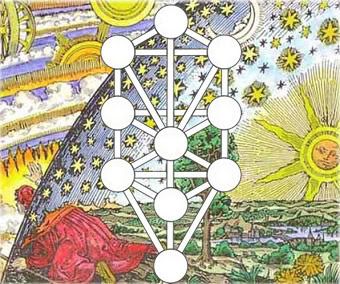
Gnostic Parallels In The Qabalah


As a student of both Gnosticism and Qabalah, I began to find many similarities between the two, and wondered just how deep the parallels went. Indeed, it made me question if the Qabalah was influenced by Gnosticism, which even the Qabalistic scholar Gershom Scholem wondered in his many excellent books on the subject. It seems likely that this is so, at least in the Lurianic school of Qabalah, but for now I will content myself with merely pointing out the parallels and letting my readers come to their own conclusions.

  1. God is conceived of as beyond the Three Negative Veils of Existence, (Limitless Light, Limitless, and Nothing), as the Unmanifest, in the Qabalah. Likewise it was common Gnostic principle (as well as being a general approach in mysticism as a whole [see the Cloud of Unknowing, for example]) to define God in negative terminology.
  2. While the above is true, God was also seen as part and parcel of the entire manifest universe, while also being beyond the Three Negative Veils. This is called panentheism, believing the universe to be part of God, but not all of God, which is in stark contrast to pantheism. Of course, there were many Gnostics who claimed definitively that the world was not in the least bit divine, but there were also many others who believed otherwise - the Valentinians in particular. They shared a predominantly panentheistic view. This can also be found in the Qabalah, where God is present in all the Sephiroth, and yet there is also part of him that is Unmanifest, beyond the Veils.
  3. The process of emanation in the creation process ("emanationist cosmogony") is part and parcel of, at the very least, Sethian and Valentinian belief. It is a typical point that, in a sense, defines Gnosticism (though, of course, not all Gnostics adhered to this, but this is pushing the term to its most open and inclusive). At the very least, the Sethians are the only group to actually call themselves Gnostics, and since they believed this, it is the most definitive source, in terms of scholarship, for defining the belief. The Qabalah shares this cosmogony, with emanating Sephiroth instead of Aeons. Indeed, the Aeons often numbered 10, the number of the Sephiroth.
  4. God of the Manifest Universe, either seen in Chokmah or Kether, is not the "real God" - you see a beared man in Chokmah (traditional "man in the clouds" god), or a bearded man in profile in Kether, showing you can only see one side of God. This is very similar to the conception of God throughout Gnostic myth, with the God of Chokmah or Kether (depending on your source and personal inclination), who is the "Creator God", being equated as the Demiurge.
  5. Gnosticism espouses a belief in a Divine Spark in Man. Qabalah also espouses this belief (via the Yechidah, etc.). See here and here for Qabalistic passages by the Baal Shem Tov on the Divine Sparks.
  6. Gnosticism teaches us that this world is a fallen one (sometimes likened to a prison, which the Qabalists would not necessarily have agreed with), with the Divine Sparks trapped inside. It must be raised up and restored to its original condition. This is a pivotal belief in the Qabalah, which focus on the Tiqqun ha-Olam, the Restoration of the World. This usually takes the form of Malkuth being fallen and requiring reunion with Tiphareth (see here for my Qabalistic Cross material on Tiqqun as an illustration of this).
  7. There is a feminine form of Divinity in Gnosticism, which is termed Sophia. The Qabalistic equivalent, often used by many modern Gnostics, is the Shekinah. Sophia was once one of the primary emanations, but has now become trapped in the physical. This is mirrored in the Qabalah, where Sophia (or Barbelo in her higher Sethian aspect) lies in Binah, but her fallen counterpart lies in Malkuth. Interestingly enough, Sophia is Greek for "Wisdom," while Chokmah is Hebrew for "Wisdom". Some Qabalists would attribute the Demiurge to Chokmah (while others will choose Kether or even Chesed), and the Demiurge is typically linked to Saturn, which is attributed to Binah. Thus we have a kind of reversal of attributions of Sophia and Demiurge between these two Sephiroth in the Qabalah.
  8. The most important principle about Gnosticism is Gnosis, experiential knowledge of the Divine. While the Qabalah does not have a direct equivalent, Gnosis is usually translated as "Knowledge", with a potential equivalent being the Hebrew Da'ath, also translated at "Knowledge". To access the Supernal Realm the Qabalist must peruse Da'ath, or, to put it another way, Gnosis allows us to experience the heights of Divinity. This is a fundamental hidden principle to Qabalah.

These are but a few of the parallels I've found between these two systems, which, as both a Gnostic and a Qabalist, have allowed me to use them together without contradiction (and have allowed me to explain Qabalistic ideas in Gnostic terms, or Gnostic ideas in Qabalistic terms). There are many more parallels, including the Sepher Yetzirah and Sepher ha-Bahir. I will be exploring these in a more indepth article on this matter in the future.

Friday, July 04, 2008

No Setting Free Of Captives Is Greater

"The holy sparks that fell when God built and destroyed the worlds, man shall raise and purify upward from stone to plant, from plant to animal, from animal to speaking being. It is known that each spark that dwells in a stone or plant or another creature has a complete figure with a full number of limbs and sinews, and when it dwells in the stone or plants, it is in prison, cannot stretch out its hands and feet, and cannot speak, but its head lies on its knees. And, whoever, with the good strength of his spirit, is able to raise the holy spark from stone to plant, from plant to animal, from animal to speaking being, he leads it into freedom, and no setting free of captives is greater than this. It is as when a king's son is rescued from captivity and brought to his father."

- Baal Shem Tov (via Rev Yakov Leib HaKohain)

Thursday, July 03, 2008

The Bottle, Not The Wine

"The Christ may have been in Jesus, but Jesus was not the Christ. He was the bottle, not the wine; the lightbulb, not the light; the wrapping, not the gift; the birdcage, not the bird."

- Reb Yakov Leib HaKohain

Wednesday, June 25, 2008

Commentary On "The Ten Major Principles Of The Gnostic Revelation", Part 1

1. The creator of this world is demented.

The Demiurge. "Demented" implies that he is deluded, a bit mad, as it were. This falls in line with Gnostic teaching that the Demiurge is deluded enough, egotistical enough, to believe that he is God, that there is naught before, above, or beyond him, and that we are his Creation.

2. The world is not as it appears, in order to hide the evil in it, a delusive veil obscuring it and the deranged deity

Like in the Matrix, this is a false world, or as the Buddhists would say, an illusion. A veil obscures us from seeing anything spiritual or non-physical, let alone anything else. Spiritual practice begins the process of piercing this veil. In the Qabalah that are multiple veils - between Malkuth and Yesod, signifying the astral, between Yesod and Tiphareth (Paroketh), signifying the Higher Self (which is mentioned in a later part), and between Tiphareth and Kether (the Abyss), our Divine Spark, the Yechidah (and then three further Veils to the Unmanifest: God). We're living in a dream world, living dream lives, and, like all dreams, it's entirely illusory and entirely transitory. The goal is to wake up.

3. There is another, better realm of God, and all our efforts are to be directed toward
a. returning there
b. bringing it here

The God beyond "God" (the Demiurge). Not the caricature of the old white-bearded man sitting in the clouds, but the real indescribable nothingness of God beyond the Veil. We must strive to return to this realm of God (the Pleroma, the Fullness), which is where we came from; and this same process involves bring it here. We elevate the physical to the spiritual, but we also invoke the spiritual into the physical. This is the Kingdom of God on Earth, the New Jerusalem.

4. Our actual lives stretch thousands of years back, and we can be made to remember our origin in the stars.

We are older than we think. These physical bodies of ours are but imitations of our true form, which is inimitable. Our lives are eternal, and our origin is far from here, far in the depths of the Fullness of God. When Crowley said "Every man and woman is a star", what do you think he meant?

5. Each of us has a divine counterpart unfallen who can reach a hand down to us to awaken us. This other personality is the authentic waking self; the one we have now is asleep and minor. We are in fact asleep, and in the hands of a dangerous magician disguised as a good god, the deranged creator deity. The bleakness, the evil and pain in this world, the fact that it is a deterministic prison controlled by the demented creator causes us willingly to split with the reality principle early in life, and so to speak willingly fall asleep in delusion.

The Higher Self. We must elevate our consciousness from this sleepwalking state, puppets of circumstance, into the consciousness of our Higher Selves, who pull the strings. Then we are no longer sleeping, and no longer prisoner to this dangerous magician, this demented creator. The reunion with our Higher Selves is the remembrance of that which we've always had, and when we were born into this "reality" we were forced to forget it, forced to obey a set of rules that never should apply to God, and never should apply to us. These rules are: Death, decay, deception, and dumbness.

I'll explore the next five in another post another day.

Friday, June 20, 2008

Suffering & Deliverance From Suffering

"One thing only, brothers, do I proclaim, now as before. Suffering and deliverance from suffering."

- Buddha

Thursday, June 19, 2008

Salvation

Salvation, like many words and topics, is very misunderstood. From a Gnostic viewpoint, Gnosis offers salvation. Gnosis is knowledge of the Divine, which is also simultaneously knowledge of the self (see here). Thus, it is in no way contradictory to the idea that your spiritual evolution is up to yourself. It is. And you are ultimately the one who "saves" yourself. What you save yourself from can depend on your tradition. It might be the prison of the Cosmos, the cycle of samsara, or simply: ignorance. In the end, they are all the same thing.

""Salvation" must be self-induced and self-devised."

-Israel Regardie, The Tree of Life

I think we may have inadvertently "tabooed" the word "save", since so many people want to "save our Souls". Only we can do that. A Gnostic does not see Christ (Soter, the Saviour) as an external agent, or would only see him thus in order to personify the Higher Self (as all traditions do). The Qabalistic assignation of Christ and similar mythological figures to Tiphareth is in accordance with this.

Salvation, as someone pointed out to me recently, implies that we have a debt to pay (original sin, etc.). In this modern age of reclaiming our authority over our own lives, this is not an acceptable notion. But in a sense, we do have a debt - a debt to ourselves. It's our failure to recognise the truth about ourselves, about our divinity, about the world around us (and how the physical isn't everything), that results in us being fallen. The Fall may only be a state of mind, an illusion, the product of ignorance, but this is what mythology is all about - describing these things. In the end, there's something wrong with us here - otherwise we'd all be enlightened. It's this lack of enlightenment that we need to be saved from, even if the Saviour is ourselves.

Sin, as so many of us Gnostics point out, did not originally mean "a spiritual crime", as it is often depicted today. It simply meant "missing the mark". We missed the mark. We took a leap and we fell. We do not have to throw out concepts; we can simply reinterpret them, as Gnostics have done for millennia. A Gnostic might also accuse the Demiurge of committing the original sin, the sin of ignorance, a sin against the true divinity of God beyond the Veil. See an old poem of mine for more on this potential interpretation.

Tuesday, June 17, 2008

Poetry: Demons

I wrote a new poem today on the topic of demons. You can check it out here:


We all have to face our demons some day. Indeed, the very phrase "face your demons" is ingrained in our modern psyche, but what exactly does it mean? In Jungian terms it is the Shadow, all the parts of ourselves we do not like, the parts we ignore and repress; and one day it rebels against us, like a child locked away in his bedroom. In the end we find we neglect our Shadow. But is it the same as our demons? Is our Shadow made up from our demons? It is the Nephesh of the Qabalah, our animal nature, and it does us the good service of taking all our unwanted junk. Its reward: we shun and ignore it. We must, of course, sacrifice our demons, our Lower Self, before the altar of the Higher. But we also need to open the locked door; we need to make amends for our neglect, for ultimately we find that the dog-face is merely a mask, and when we demask our demons we might be troubled at what we find. And when we become troubled we will be astonished, and we will rule over the All.

Monday, June 16, 2008

My New Blog...

I've created a new blog to deal with my more overtly occult topics, particularly within the stream of the Golden Dawn tradition. You can find it here:


Meanwhile, I'll continue to post my Gnostic musings here.

Sunday, June 15, 2008

A Summary Of My Spiritual Beliefs

I was recently asked on my forum Occult Ireland what a summary of my religious/spiritual beliefs were. This is not an easy question to answer, as a synopsis of belief is often vague and lacking in the subtleties that a thoroug exposure, discussion, or debate might offer. However, it's also a good excercise, as it forces you to think about how you can communicate what you believe to others, especially in a short, simplified, and coherent manner. Below you will find my answer to their question (noting that they assumed that Enochian was my main spiritual interest from other posts of mine).

A Summary Of My Spiritual Beliefs

Enochian is only one of my three prime interests. These are:

Qabalah
Gnosticism
Enochian

I've spent the last four years, with the O.'.S.'.D.'.L.'., dedicated to studying Enochian, from Golden Dawn material to the original Dee material to more modern work like that of Benjamin Rowe.

I am, however, much more intrinsically fascinated by the Qabalah, and it meshes so well with my Gnostic beliefs (as does Enochian to a certain degree). It is difficult to summarise beliefs, but I will take a "stab" at it:

1) I believe in God, though I use the term merely for simplicity's sake. The true God is both immanent and transcendent (i.e. part of this world while also beyond it), so this can be characterised as panentheism. This God is also beyond description. We cannot say what he is, but more what he is not: illimitable, indescribable, etc. This type of unknowable God belongs to both Gnosticism and Qabalah (the Three Negative Veils).

2) In contrast to this, I believe in a lesser form of Deity - i.e. the Demiurge and Archons, who are the Creators and crafters of the physical universe (the Cosmos). Through a divine mistake, on behalf of Sophia, the forces of ignorance were created, as opposed to the emanation process which previously occurred with God (i.e. when God emanates his divinity, all is well. When something is created, however, something goes wrong). This emanationist cosmogony belongs to both Gnosticism and Qabalah (Aeons and Sephiroth).

3) I believe that God has fallen, to a certain degree, and is trapped in the physical world (not all of him, however, as he is also transcendent). This is Sophia of Gnosticism, the Shekinah of Qabalah. We are the Sparks of God (Yechidah in Qabalah), and our goal is to escape our physical prison (which is, like in Buddhism, an illusion), which is achieved through the Saviour, the Christ, who we become (in Tiphareth). This fallen state is known as Malkuth in Qabalah, which acts as a pendulum to the Tree. The goal, known as Tiqqun, the Repairing of the World, is to reunite Malkuth, the Kingdom, with the King, Tiphareth. This is frequently symbolised in Qabalistic teaching. Reincarnation is a form of entrapment that must be escaped to unify with God (this is essentially the same teaching as Buddhism's samsara).

4) I believe, like all Gnostics, that this salvation is only achieved through Gnosis, direct experiential knowledge of the Divine. Faith has its place as a pre-runner to Gnosis, but it is Gnosis alone, which is, in actuality, anamnesis, the act of remembering (such as remembering our divinity, our origin in God, our imprisonment, our ultimate knowing of all things, and our ability to save ourselves and, thereby, save God), which Plato taught about (which was thenceforth absorbed, like many Platonic teachings, into Gnosticism), that saves us. In the Qabalah, Knowledge is Da'ath, and thus it could be said that the goal of a Gnostic is to cross the Abyss into the Supernal Realm, the Garden of Eden. This is, in effect, the Tiqqun, for the Fall was us being thrown out of the Garden of Eden, and thus humanity's Rise is the re-entry of that Garden.

These are just my main beliefs, and don't explore all the subtleties, but I would have no problem describing myself with any of these terms:

Jewish
Gnostic
Christian

If we look at the early Gnosticism, we will note that it was both Jewish and Christian, and, indeed, the early Christians still considered themselves Jews. I would, in turn, follow suit. There is much of value in the Christian teachings, primarily that of the dying-and-resurrecting Godman, the Christian Rosenkreutz of Rosicrucianism, but, as a Qabalist, I have a very big soft-spot for Torah and the Hebrew bible (and language).

In comparison to the above, I only employ Enochian when I need to. It is a system of magick, and you can believe what you will and still practice it to great effect. I am actually more enamoured by the Qabalah, and have always been.

Why not try a summary of your own religious/spiritual beliefs?

Friday, June 13, 2008

Poetry: Revenge

I recently published a new poem on the topic of "Revenge" at Helium. You can check it out here:


Vengeance is something all of us have to deal with, and it can be a hard one to manage. We all get angry, and anger is a healthy emotion, despite what we may think of it. Anger is the natural response to something or someone hurting us in some way. It may be trivial, or it may be epic in scope, depth, and application. Regardless, vengeance is the extreme end of anger, when we fail to forgive, which is not, admittedly, an easy thing to do. Vengeance brings us over the edge, and it can be hard to come back from the darkness that it leads to. I hope I have made this clear in my poem.

I pray that we all, myself included, learn how to forgive, and that when someone wrongs us, we do not wrong them in return, but express our dissatisfaction and, if necessary, remove ourselves from the situation. Let us not get caught up in the cycles of revenge, for they lead to no good places. Let us, instead, try to understand one another, and express our anger in a productive and healthy manner. Lord, in token of this, forgive us for all that we have done to anger others, and I ask for the forgiveness of these people, whether they feel ready to offer it or not. Let us also remember not to judge someone on their readiness to forgive, for we cannot understand the pain they may feel. Lord, grant us empathy and understanding, that we might live in a better world.

Amen.

Tuesday, May 06, 2008

The Archons As Planetary Forces

Many Gnostic texts display the Archons as the 7 “old planets” (Mars, Venus, Sol, Luna, Mercury, Jupiter, and Saturn), and most of them attribute the Demiurge (as head of the Archons) to Saturn. So, does this mean that the Gnostics of old actually believed in evil entities that existed “up there” who rule the fate of humanity? Or does it mean that many Gnostics saw these not as beings, per se, but more in an astrological sense, as the planetary influence upon our lives?

We know from Science that the Moon (Luna) has an actual effect on water on this planet, on the tides, and even on the menstrual cycle of women (which is tied up in the cycles of the moon). The moon is also said to affect the minds of men and woman (after all, we are dominantly made of water), and asylums frequently report more “madness” at the time of a Full Moon. Indeed, this is where we get the terms lunacy and lunatic form: luna-cy and luna-tic.

We know from sheer existence that the Sun (Sol) has an actual effect on the life of this planet, and that without it life could not exist. It provides heat. It helps plants grow. It even affects our moods, for when the sun is less frequent in Winter many people report the “winter blues” (which is why so many religions have adopted solar ceremonies in an attempt to off-set this). Indeed, some modern research indicates that the flu virus becomes prominent in winter simply because our Vitamin D levels have been depleted by lack of sunlight.

Now, I’m not as well-versed, scientifically-speaking, on whether or not the other planets have such a noticeable affect on us here on Earth, and, if so, what those effects might be. However, it doesn’t take much of a leap to consider that they do, given their proximity, have an effect on things here. This is what astrology teaches us.

What if the bondage of the Archons is the bondage to our “fate”, delineated in our natal chart in astrology? What if it is the bondage to the effects of the planets on our lives? What if freedom from them involves planetary workings to off-set these effects? What if, for example, a writer lacking in Mercury in his chart (the planet best associated with writing and the intellect), knowing that he is bound by the forces of the Archons to produce inferior material, propitiates Mercury, invokes this planetary energies on a regular basis? What if a volatile person banishes Mars energies? Is this the work of a Gnostic? Is this part and parcel of some of the ancient ceremonies that Gnostics carried out?

Now, let’s look at Saturn. Some people point out the remarkable similarity between the name “Saturn” and the name “Satan”, and perhaps the Gnostics of old were some of those people (after all, some Gnostics equated the Demiurge with Satan). Saturn is the most malignant planet in our system. He is, in essence, the primary force of bondage. He is Death. The image of the Grim Reaper was originally an image of Saturn. If Yahweh in the Old Testament is the Demiurge, and his kicking humanity out of Eden was the removal of humanity’s primordial immortality, then he is the instigator of Death, and he is, thus, Saturn. In Western Astrology there is a thing called a “Saturn Return”, which is basically the time when Saturn returns to its original place in your birth-chart (taking roughly 30 years to do so). Then follows a 2 year period of, effectively, “bad luck”. Vedic Astrology has something similar, called a Sade Sati, which lasts for a painstaking 7 and a half years (I’ll take the 2 years please!). Again, the emphasis is on bad stuff happening: accidents, loss of money, illness, friends and family dying, etc. All in all, Saturn is seen as the “big bad daddy” of the astrological system. Of course, Death is also transformative, as anyone with even a cursory knowledge of the Tarot or the dying-and-resurrecting-gods mythoi will know. But the emphasis is still that Saturn is bad, and it’s easy to see how the Demiurge came to be associated with him.

I’m pushed for time at the moment, but the purpose of this short post is to illustrate the different ways we can look at the mythology available to us. This is one way we can look at the Archons of old in modern light, and one that may feel most at home for all the astrologers among us. How do the planets affect us? And how do we make the most of their good effects and lessen the effects of the bad?

Monday, May 05, 2008

From Everlasting To Everlasting

"The corn was orient and immortal wheat, which never should be reaped, nor was ever sown. I thought it had stood from everlasting to everlasting. The dust and the stones of the street were as precious as gold; the gates were at first the end of the world. The green trees when I saw them first through one of the gates, transported and ravished me, their sweetness and unusual beauty made my heart to leap, and almost mad with ecstasy, they were such strange and wonderful things. The men! O what venerable and reverent creatures did the aged seem! Immortal Cherubim! And the young men glittering and sparkling angels, and maids, strange seraphic pieces of life and beauty. Boys and girls tumbling in the street, and playing, were moving jewels ... I knew not that they were born or should die. But all things abided eternally as they were in their proper places. Eternity was manifest in the Light of the Day, and something infinite behind everything appeared ..."
and
"All appeared new and strange at first, inexpressibly rare and delightful and beautiful. I was a little stranger which at my entrance into the world was saluted and surrounded with innumerable joys. My knowledge was Divine; I knew by intuition those things which since my Apostacy I collected again by the highest reason. My very ignorance was advantageous. I seemed as one brought into the state of innocence. All things were spotless and pure and glorious; yea, and infinitely mine and joyful and precious. I knew not that there were any sins, or complaints or laws. I dreamed not of poverties, contentions, or vices. All tears and quarrels were hidden from my eyes. Everything was at rest, free and immortal. I knew nothing of sickness or death or exaction. In the absence of these I was entertained like an angel with the works of God in their splendour and glory; I saw all in the peace of Eden ... All Time was Eternity, and a perpetual Sabbath ..."

from Centuries of Meditation by Thomas Traherne (via the Introduction to Israel Regardie's The Golden Dawn)

Tuesday, April 22, 2008

Deus Matter

"Matter, you in whom I find both seduction and strength, you in whom I find blandishment and virility, you who can enrich and destroy, I surrender myself to your mighty layers, with faith in the heavenly influences which have sweetened and purified your waters. The virtue of Christ has passed into you. Let your attractions lead me forward, let your sap be the food that nourishes me; let your resistance give me toughness; let your robberies and inroads give me freedom. And finally, let your whole being lead me towards Godhead."

- Teilhard de Chardin, The Divine Milieu

Sunday, April 06, 2008

Jesus On Asceticism

In early March I was asked to share my thoughts on Asceticism and how it applies (if at all) to Gnosticism. I’m admittedly not a fan of it, and recommend only brief stints of abstinence from food, sex, and other sensory pleasures – almost purely to develop the Will. Now I will share some of Jesus’ teachings on this subject from the Gospel of Thomas:

His disciples questioned him and said to him, "Do you want us to fast? How shall we pray? Shall we give alms? What diet shall we observe?"
Jesus said, "Do not tell lies, and do not do what you hate, for all things are plain in the sight of heaven. For nothing hidden will not become manifest, and nothing covered will remain without being uncovered."

- Logion 6


Jesus’ disciples ask him what practices they should do to be worthy, and many of the things they ask are physical observances. Should they restrict their diet (i.e. not eat meat) or fast? Should they give offerings to the temple and the poor? Should they pray, and how shall they pray?

Jesus does not give them the law. He does not say: do this and don’t do this. All he says is: “Do not tell lies”, for isn’t the observation of a diet that you do not truly wish to keep a lie? Isn’t the giving of alms which you do not wish to give a lie? Isn’t the doing of anything that you do not truly wish to do a lie? Jesus tells us: “Do not do what you hate”. Do not restrict your diet or avoid sex or create this image of false piety, for “all things are plain in the sight of heaven” – God sees all, and he knows the truly pious of heart from those who don the vesture of piety. You do not enter the Kingdom of Heaven by changing your diet or restricting your desires. These are just as much a part of the illusion as everything else. The Key to the Kingdom is inside you. You can use fasting to find it, and you can use fasting and find nothing. You can’t do A, B, and C and magically attain enlightenment.

Jesus said to them, "If you fast, you will give rise to sin for yourselves; and if you pray, you will be condemned; and if you give alms, you will do harm to your spirits. When you go into any land and walk about in the districts, if they receive you, eat what they will set before you, and heal the sick among them. For what goes into your mouth will not defile you, but that which issues from your mouth - it is that which will defile you."

- Logion 14


This is a very striking verse. Jesus says that these practices will result in bad things. While it is perhaps safe to assume that this is a bit of a hyperbole on Jesus’ part, the real crunch of the matter comes with his explanation. He encourages hospitality – eat what is offered to you, for it is rude to observe a diet that results in rejecting that which is offered to you by your host. Heal the sick no matter what time or day. Do not allow good will to be restricted by these conventions of man. What enters you mouth (food) is not as important as what issues from it: words. Those who deal in tainted words shall be tainted by them. Control what you let leave your mouth, not what you let enter.

I sill leave with the remaining passages from the Gospel of Thomas that deal directly with his views on ascetic practice: May those with ears to hear, hear:


Jesus said, "Do not be concerned from morning until evening and from evening until morning about what you will wear."

- Logion 36


His disciples said to him, "Is circumcision beneficial or not?"
He said to them, "If it were beneficial, their father would beget them already circumcised from their mother. Rather, the true circumcision in spirit has become completely profitable."

- Logion 53


Jesus said, "Why do you wash the outside of the cup? Do you not realize that he who made the inside is the same one who made the outside?"

- Logion 89


They said to Jesus, "Come, let us pray today and let us fast."
Jesus said, "What is the sin that I have committed, or wherein have I been defeated? But when the bridegroom leaves the bridal chamber, then let them fast and pray."

- Logion 104

Motivation

Apathy is a dangerous thing. If we do not care about our planet, who will protect it, who will save it? If we do not care about our children, who will nurture them, who will teach them? If we do not care about our friends, who will they turn to in times of need, who will be a friendly ear, a helping hand? If we do not care about what we do, who will do it, and why?

Motivation is an area that many people feel they lack in, yet they may be surprised to find just how motivated they can be when it comes to certain things. We might complain about the lack of motivation we have to go to work, but we may be highly motivated to buy a new house or new car, or even to read a book, watch a movie, or have an in-depth discussion with someone.

If we’re not motivated to do something, we rarely do it, or reluctantly and begrudgingly do it. We may want it done, but we don’t want to do the “doing”. In these cases, what do we do?

Motivation comes in two primary forms: negative and positive.

Negative motivation comes in the form of us being driven to do something for fear of the consequences. For example, we go to work so we don’t get fired, lose our money, our house, our car, and possibly our family. Someone who is negatively motivated may visualise all these nasty things happening if they don’t go to work – and this motivates them to go to work. It doesn’t sound very nice, and it isn’t. This form of motivation is about avoiding painful experiences. You’re not motivated towards riches, but are motivated away from poverty.

Positive motivation comes in the form of us being driven to do something because we want the rewards it offers. We go to work because we want the money, or maybe we like the “good job!” pat-on-the-back sentiments, or maybe we like team-work, or if we’re in a supervisory role we may like feeling in control. Whatever it is, we do it because we like what it gives us, be it money, happiness, or just personal satisfaction. We may even take up dead-end jobs because it goes towards something we’re striving for: a new apartment, a new car, that trip to a spa. We put in the overtime and do the hard work because we envision a goal we want. This form of motivation is about approaching pleasurable experiences. You’re not motivated away from poverty, but are motivated towards riches.

Once we understand this basic premise, it’s easier to deliberately motivate ourselves. “What?!” I hear some of you cry. Many people seem to think that motivation is an external force, like some big bad Demiurge pushing or pulling them towards success or misfortune. Many artists and writers seem to think that their muse is an external entity that comes and goes as it pleases, and that they cannot do a thing in their craft until inspiration strikes. They’re wrong. Inspiration and motivation work on the same system, and both are under our control. The reason they feel so external is because we’re too used to going on autopilot. Now it’s time to take he reins.

Firstly, what I want you all to do is this: think of something you want to me motivated about. Maybe you want a new job or new car. Maybe you want to write a novel. Whatever it is, get a good mental picture of what you want. This is your goal. Now, how do you get motivated about it? Try this: play out a scenario in your mind of you at the desk in your new job (if there is a desk – if not, demand one from your boss), actually there, doing the work. Imagine getting your new paycheck, and make special note to pay attention to the nice sum of money you’ve earned. Imagine looking in your bank account at the savings you have after just one year at your new job (even if you feel you can’t save to save your life). Imagine the great place you can now afford, the new TV, the new car. Likewise, imagine driving this car. Imagine picking it out in the shop and driving it home. Hell, imagine all the women or men turning heads as you glide past, sunglasses on, the wind in your hair (if you have no hair, imagine you have some, or imagine a woman or man in the back seat giving you a lovely Indian head massage). Imagine yourself smiling. Now really smile if you aren’t already. Invoke the feeling of pleasure. Let it well up inside you, let it fill you with its warmth, with its energising rays, as if the very Sun itself bows down to you and becomes a part of you. Imagine writing your book. Imagine yourself at the laptop as you complete your first 1,000 words, then 10,000, then 50,000, then 100,000. Imagine the satisfaction of a chapter completed. Imagine the greater satisfaction of the whole novel completed. Imagine sending it off to agents and publishers, and imagine receiving a lovely acceptance and being invited to a nice wine party to celebrate. Imagine reading an extract and receiving a wild applause, and maybe even a standing ovation. Imagine receiving a copy of your book in the mail. Feel the satisfaction it offers. Imagine all those wonderful praises the reviewers give: “Best thing since sliced bread. Tolkien or Stephen King, eat your heart out!” Imagine the sales figures jumping through the roof (then imagine a very high roof). Imagine the lifestyle you can live now. Imagine being able to whip out a copy of your book and finally prove you’re a real author.

Now, once you’re finished imagining all this, go out and do it. Make it real.

Monday, March 24, 2008

"Aleph" & "Teth"

Two of my esoteric poems on two of the letters of the Hebrew alphabet were published in Issue 2 of "Hidden Spirit" here last year, but not they've been reprinted online in the Journal of the Western Mystery Tradition, so I thought I'd share the links:

Aleph

Teth

Wednesday, March 05, 2008

The Book Of Beth

The Book of Beth

by Fr. J/Yachin


1. The House of God has many colours, and it has ten rooms, and it has four floors. It is built of a stone that has no form, and the blueprints of the house are hidden in the words of the Architect.

2. The foundations are strong, yet this house was first built from the roof downwards; each person who enters it shall build it anew from the foundations up.

3. There are two main floors of attainment, a basement at its base where Man is cemented in form, and a roof that opens out into the sky, where the Air is full for the breathing.

4. And God is found through Spirit in the House, the Air that blows here and there; and He is found at the back of the House, where the back door is open to the fullness of His infinite majesty.

5. The breath is as a gale from the East, so the House was built to face the West, for the builder must face the tools of his creation.

6. A King must build a Kingdom, and the beginnings of His Kingdom start with His House.

7. The Kingdom is the Door to the House of God, and you shall enter by the basement, where the chamber is damp and moist.

8. The clay is broken and built up over years, and weeds from the desecrated garden slither in and out of cracks and crevices. There are seven weeds that coil and spring, and they are the Rulers of the garden.

9. The basement is dark, yet there appears to be three passages where light streams down, and the light of a Great Lantern above illuminates the moss and the mould below.

10. The Basement is cluttered and overgrown, and the garden needs tending, lest the weeds overrun the garden above, smothering the roots of the tree that knows no bounds.

11. The people of the Kingdom must beseech the King, and they must approach His Palace by way of the steps that rest upon the foundations.

12. The Palace hides a Temple, and you shall not shake the foundations of the Temple, lest it be to raise new steps to the Summit.

13. The King has a Seat in the middle, but you must pass through His guards; one is a pillar of strength, the other a pillar of mercy. You must thread the path between them, and this path encompasses a second stair.

14. The King sits upon a Crossroads, and he has six wings, and he has eight arms, and these arms point in seven directions, and one points at you.

15. The King hears the words of His people; then He casts off His robe of glory and they hear the Word of their King: Tiqqun.

16. The Garden of God’s House needs gardeners.

17. The people must cross into the Heavenly Garden to know what tools they need; a third stair waits for them, and these steps are as a bridge, and each step is formed from their thought.

18. Stray thoughts create stray steps, and you shall stray with them. Keep then to the Way and you will keep your footing.

19. The Attic appears dusty, for it has seen little use by Man; but you grow to find that the dust is merely in your eyes, for there is no dust in this place.

20. What you see you will drown in, so keep to the goal of the garden and meet with the one who drew its bounds.

21. He will have the blueprint, but He has another Master, and this is the King Above.

22. God is in the Rafters.

23. Take a Ladder of Ten Rungs and you shall meet Him, yet you shall not glance upon His fullness, lest you become smoke and ascend into the clouds, where His majesty is unknowable and true.

24. There are three great clouds which obscure your view; the concentration of condensation is thickest near the chimney top, and this cloud is as a Limitless Light, so bright as to blind the onlookers who are not meet to meet that which is above.

25. Should you penetrate that (Heaven of Heavens be praised), you will see the Limitless, and there the Mind of Malkuth crumbles, for none can look upon the Infinite and live.

26. Life is only Life in the Light, and you shall have Life from the Limitless Light.

27. Your old eyes will melt, and you shall be given new ones, and you shall see the majesty of He that is unknowable and true, for sight is the sword that cuts the Veil, and sight is the source of penetration to the Source, where you shall see Not.

28. There is no Darkness here, nor is there Light; there is no Day, nor is there Night; even the Monad ceases to Be.

29. Hail the majesty of He That Knows No Bounds; and Hail the majesty of He Who Knows Not, for He is the Knower of All.

30. He Who Knows All knows how to mend the garden of God’s splendour, and he gives three commands:

31. You shall keep the weeds down, for they choke the flower of God’s worth.

32. You shall plant new seeds, for the Sower is the Reaper, and those who plant well supplant the Throne of Saturn.

33. You shall know the Tree by its roots; climb to the top and you will see them.

34. This is the glory of God’s Garden, and the glory of His Garden is the glory of His House.

35. Those who know God’s House know the manner of His living, and those who know the manner of His living know the mystery of His life.

36. The mystery of His life is found by the back door, yet few will think to open it.

37. So ends the Book of Beth; it ends in Silence.


For anyone who wants a nice PDF copy of the above, click here.

Tuesday, March 04, 2008

Asceticism & Why Starving Is Bad For You

Asceticism is the practice of extreme abstinence, primarily in a spiritual context. Think: No sex for the priests and no alcohol for the Muslims. Only, chances are that a true ascetic will abstain from both, as well as perhaps many (if not most) types of food and other physical and sensory pleasures (TV, music, books, games…).

“Now, why would anyone do this?”, you might ask. Surely food, for one, is a good thing? Well, that depends. If we look at the theological and philosophical side of things, it’s easy to see where the practice of asceticism came from.

Humanity tends to think in a dualist way. It’s either right or left, up or down, in or out, off or on. We’re talking good and bad here, heaven and hell, spirit and matter. I blame the Fall for our divisive nature, but even this blame game is a divisive comment, failing to acknowledge that I am the Fall just like everyone else is (and also the Restoration, but we’ll leave that for another topic). It’s this dualistic form of thinking, so natural for us as (seemingly) separate entities from God, that makes us wonder: If we want to be up “there”, doesn’t that mean we have to stop being down “here”?


In a sense, yes. Now, let’s follow this to a logical conclusion. “There” is, perhaps, heaven. It’s God. It’s the Pleroma. It’s spirit. “Here” is earth. It’s matter. It’s physical. The common Gnostic belief is that we (our true spiritual selves [our divine spark]) are trapped here in our physical bodies, in this physical world, on this physical plane of existence. Woe is us. In general terms, it’s pretty easy to be consumed by this world, to be consumed by consumerism and commercialism and the con of “this is all there is” physical existence. We might be striving for the American Dream. We might want a house, a job, a family. And it’s very easy to forget about the spiritual, to let those godly whispers be drowned by the rush-hour noise of our hustle-and-bustle everyday lives. So what do we do? We abstain.


Sex is pretty distracting. I don’t need to back up that comment. We all know that. Humanity is a very horny species, particularly with that blissful realisation that sex feels good, and isn’t, as we currently utilise it, just for procreation. Chances are that if you’re eyeing every passing woman (or man) because you’ve got “the urge”, you’re probably not thinking about God. Crowley sex magick aside, most usage of sex (am I making it sound like a game console?) tends to be a purely physical endeavour. In order to avoid this distraction, we can abstain from sex and dedicate ourselves more fully to the spiritual side of things. This is the primary theological argument for priests abstaining from sex and/or marriage. Instead of dividing their attention, they effectively marry the Church, thereby allowing a fuller form of spiritual dedication.

Alcohol. Personally speaking, I don’t drink (or shall I say, very rarely [once in a blue moon] do), but I don’t have any religious reasons for doing so. I think it’s safe to say, however, that abuse of alcohol is quite high, especially in modern society. It’s no surprise that many people of a strong religious persuasion (like followers of Islam) refrain from drinking. Not acting like a fool, not throwing up, not having a hangover, and actually remembering what happened tend to be seen as good things. Unlike other drugs that may open you up to spiritual experience (however chaotic or limited those may be), alcohol tends to inhibit the spirit just as much as it releases your earthly inhibitions.

But what about food? Well, we could say that vegetarianism is a form of abstinence. Asceticism goes a bit further than that. In extreme cases it can actually involve the complete refusal of food for extremely long periods of time. Sometimes only basic survival is encouraged. I don’t think that’s healthy at all, and I’m talking spirit-healthy here as much as healthy in a physical sense. Yes, food is a physical thing, and eating will strengthen the physical body, but taking the division of body and soul to such an extreme tends to miss the point entirely. Let me put it simply: if you don’t eat, you will die. I don’t care if your soul still lives, you’re dead and there’s nothing you can do now to set your soul free. Remember, this prison isn’t just your physical body. There’s a whole cosmos here, an entire Matrix to break free from. If you (extreme example) commit suicide in order to escape the physical you’re more than likely going to end up back here in a new body, still trapped in the cycle of Samsara. It’s not that easy. The Gospel of Judas shouldn’t be taken literally.

What happens when a Gnostic “wakes up”? Things can get a little difficult. You see, when you start fighting the chloroform of creation, the universe starts fighting back. The Archons are loosed. Every attempt to break free is met with a brick wall and an Agent in front of it. You simply can’t break free using brute force. Why? Brute force is a physical thing. Try subtlety. Try assimilation. Try persuasion. Because if you keep fighting the physical world you’re going to end up living a miserable life here, and waking up to the truth, however frightening, is not meant to make you miserable. It’s supposed to set you free. Suffering is another prison.

God is here. Yes, he’s “there” too, but he’s here. He’s always been here. This is part of waking up. It’s the realisation that just as you are “here” in the Matrix, you’re also “here” in the real world too. God is flowing through the veins of all creation. It’s a subtle invasion of divinity, permeating all. It’s not enough to elevate yourself from the physical to the spiritual. You have to bring down the spiritual into the physical. It’s a symbiotic process. As Above, So Below.

Thus, for anyone considering asceticism as part of their practice, let me say this: There are good reasons for fasting and abstaining from certain things for certain periods of time. It helps develop your Will. It strengthens you. It highlights your strengths and weaknesses. It can aid your spiritual growth. But don’t do it because a book told you to, or because your spiritual leader told you to. And don’t put your life at risk or think that you need to suffer to grow spiritually. That’s an illusion. It’s a lie that the Demiurge feeds us when he realises he’s losing his grip on us.

All that said, if you are an ascetic or are considering asceticism, there are theological and philosophical justifications for this, and I am in no way dismissing the practice as a whole. However, for the average Gnostic, I think it’s better to nurture your body and mind so that the nurturing of your spirit is made all the easier.

I’ll end with a quote that a member of Occult Ireland forums shared recently:

"...if you kill your ego, you might kill what motivates you to embark on the spiritual path and stay on it. Therefore, do not attempt to kill your ego or even to weaken it. What your ego needs is purification, transformation, and guidance."

- Pandit Rajmani Tigunait


P.S. Kudos to Anthony for suggesting this topic.

The Disappearance Act

Tada!

Back from the dead... you know, like that fella... E.T.

Okay, so many of you might have noticed that I haven't really been around much lately. Apologies for that, and I'll try to rectify the sheer lack of posting on this blog. That's my side of the bargain. Here's yours:

In order to encourage me to post (there's an Archon out there called Laziness and he's incredibly hard to kill - get me Neo, please), why not comment with some suggestions for topics for me to tackle? Indeed, I'll even go so far as to make an oath that I will post about every suggested topic, so long as it relates somewhat to Gnosticism, religion, spirituality, philosophy, or the occult.

Tuesday, December 25, 2007

Merry Christmas!

Merry Christmas everyone! I wish you and yours the very best that the Season has to offer. May your Christmas be Merry, and may you have a happy and prosperous New Year! May 2008 bear the fruit of this year's toil, and may the mirth of this holiday carry forth into the many days ahead.

Sunday, November 18, 2007

Gnostic Lexicon

The beginning of my Gnostic Lexicon:

Allogenes – Literally “foreigner” in Greek, this is the title of one Sethian Gnostic text (found here). The “foreigner” in this case is seen to be the Gnostic, who, while in the physical world, is foreign to it (having his/her true origin in God).

Apocryphon – Literally “secret book” in Greek (plural: apocrypha), this is appended to many Gnostic texts (such as the Secret Book of John) to show that it is a text, unlike other texts, that explores the secret truth (which many Gnostics felt was withheld from more generic texts that Christians, etc., used). This is generally employed by Sethian Gnostics (the Valentinians would have seen the secret truth in the more generic texts as well).

Archon – Literally “ruler” in Greek, this is the name of one of the adversary forces that rule the Cosmos, under the dominion of the Demiurge. Some Gnostics saw these as numbering into hundreds (i.e. angels), while others saw seven Archons (i.e. the seven old planets), one of which was the Demiurge (Saturn).

Cosmos – From the Greek (kosmos), meaning “system”, this is seen as the cage from which the Gnostics are to break free from. A good modern myth of this is the Matrix.

Demiurge – Literally “artisan” or “craftsman” (from the Greek demiurgos), this is the name/title of the main adversarial force in Gnostic cosmology. He is variously seen as the Creator God (differentiated from the True God who is beyond Creation), Saturn, Satan, or a more abstract force of bondage. The term was first introduced by Plato, who influenced many of the Gnostic movements.

Gnosis – Literally “knowledge” in Greek, this is the experiential knowledge of the divine that turns a person into a Gnostic. It is a revelatory and salvational experience of communion with God, not to be confused with intellectual or book knowledge (known as episteme in Greek).

Hylic – Literally “of matter” (from the Greek hulikos), this was a Valentinian title for the people who were devoid of spirituality entirely, those who had rejected God in any of his guises (even non-Gnostic ones). They were the people who clung to matter (hyle), and made up the first group of the Valentinian three-fold division of souls.

Logos – Literally “word” in Greek (though that is but an approximate translation). Originally introduced by Plato, it was taken by many Gnostics (via the introductory passages of the Gospel of John) as a title of the Christ, and is often seen as one of the primary Aeons.

Pistis – Literally “faith” or “trust” in Greek, this is often seen as the opposite of Gnosis (upheld by the psychic group of the Outer Church), but the Valentinian Gnostics saw it as a necessary prerequisite of the attainment of Gnosis (though it was never seen as offering salvation).

Pleroma – Literally “fullness” in Greek, this is a title for the totality of the Divine, the realm of the Aeons and the True God. Reunion with the Fullness is seen as one of the primary goals of Gnosticism.

Pneumatic – Literally “of spirit” (from the Greek pneumatikos [from pneuma – spirit]), this was a Valentinian title for the people who belonged to the third of their three-fold system of grouping. These were the Gnostics, the Valentinians themselves (among others of similar theology), and were seen to be members of the “Inner Church”, the Church of Gnosis, and the highest of all three groups.

Praxis – Literally “practice” in Greek, this is a common term for practical (as opposed to intellectual) exercises that a Gnostic might undertake as part of spiritual observance or attempts towards Gnosis. Examples include ritual, prayer, and community action.

Psychic – Literally “of soul” (from the Greek psychikos [from psyche – soul]), this was a Valentinian title for the people who belonged to the second of their three-fold system of grouping. They were seen as people who had embraced a limited aspect of the divine (given in Faith), and were members of the “Outer Church”. This generally referred to the orthodox Christians.

Saklas – Literally “fool” in Aramaic, this is a common title for the Demiurge (who is seen as foolish for denying the reality of the God above him).

Samael – Literally “blind god” (or “god of the blind”) in Aramaic, this is a title for the Demiurge. The name is also found in Jewish and Christian works, variously as the Angel of Death or a demon, often equated with Satan (further enforcing its usage for the Demiurge, who was sometimes seen as Satan).

Sethian – This is the name of a dominant group of Gnostics (who were the only ones to actually use the term “Gnostic” [calling themselves the Gnostikoi], generally of a strong Jewish background. They usually refrained from using Christian references, but upheld similar theology to the Valentinians (gnosis as salvational, emanationist cosmogony, etc.). They saw themselves as the followers/children of the biblical Seth, the third son of Adam and Eve, who was seen as the balancing of the forces of Abel and Cain.

Somatic – Literally “of flesh” (from the Greek soma – flesh), this is an alternative title for a Hylic. See the entry entitled “Hylic” for more information.

Sophia – Literally “wisdom” in Greek (giving rise to the word philosophy, love of wisdom [from philo love/r and sophia wisdom), this is the name of one of the primary Aeons in Gnostic cosmology, variously seen as the feminine aspect of the Divine, as the mother of the Demiurge (who created him in an attempt to mimic the actions of God), as the fallen aspect of Divinity (in much the same way as Eve) trapped in Creation, and as the spiritual consort of the Christ (in various forms, most notable of which is Mary Magdalene).

Soter – Literally “saviour” in Greek, this is a title of the Christ. Just as Jesus is seen to be the Saviour in orthodox Christianity, Gnostics saw the Logos/Christ as the salvational Aeon that descended to rescue Sophia (and the trapped sparks of the divine within humanity) from the Cosmos and the bondage of the Demiurge.

Soteriology – Literally “study of salvation”, this is a common term in theology to describe the discussions on what is required to save humanity. In orthodox Christianity it is seen as Faith, but Gnostics taught that Gnosis was the only thing that could grant salvation.

Valentinian – This is the name of perhaps the most dominant group of Gnostics to date, the followers of the teachings of Valentinus and his disciples. They upheld a moderate form of Gnosticism, embracing the ecclesia of Christianity with Gnostic and Platonic theology, doctrine, and practice. Most modern Gnostics and Gnostic Churches are seen as Valentinian.

Valentinus – The founder of the Valentinian Gnostic movement, he was a Bishop of the Roman Catholic Church (who was narrowly defeated for the honour of Bishop of Rome [i.e. Pope]) and the most influential and popular Gnostic to date. He taught a more moderate form of Gnosticism, which was less adversarial to the Church and its teachings, and was therefore considered more dangerous as he converted more and more members of the Church to Gnosticism. His name is sometimes spelled Valentinius, and he is sometimes considered (mostly by Gnostics) as the saint to which Saint Valentine’s Day is named.

Yaldabaoth – Literally “come here, child” in a Semitic tongue (alternatively spelled Ialdabaoth or Jaldabaoth), this is a title of the Demiurge. There is no direct and accurate translation available of this, so any provided can only be an educated guess on the part of scholars.

Yaweh – A pronounced form of the Tetragrammaton (YHVH), the four-lettered name of God. This is the Creator God of Genesis, and he was often described as the Demiurge by Gnostics (especially those who raised how contradictory he seemed to the God shown in the New Testament), especially those with an anti-Semitic bent. This led to further conflict with Jews and Christians alike.

Zoe – Literally “life” in Greek, this is a name used for Eve. In this context she is seen as the daughter of Sophia (or an emanated aspect of her as the fallen goddess).

Saturday, November 17, 2007

Contentment Is The Obstacle Of Growth

Some thoughts from a recent discussion I had with someone:

Contentment is the obstacle of growth.

Suffering is almost a prerequisite of the yearning for spiritual growth. Jesus suffered. Buddha witnessed suffering everywhere.

We'll never leave the House if we're content enough to stay inside.

Happiness isn't enough. The "perfect life" isn't enough. The "american dream" isn't enough.

Because ultimately that's all transitory.

It doesn't last.

And we never truly feel any of it.

Because it never had the same sense of reality, the same sense of undeniable truth, as that which is experienced in Gnosis.

Look at Cypher in the Matrix.

He chose to go back to the System, to stay "plugged in".

He knew the meat wasn't real.

But it tasted so damn good.

The truth didn't make him happy.

It's not supposed to.

But ultimately his happiness isn't real.

So the lie doesn't make him happy either.

I was asked: Why does Neo take the red pill?

Because he has to.

Because he doesn't have a choice.

He thinks he does.

But he knows he doesn't.

The hand holding the blue pill is a ruse.

He already took the red pill - before it was offered to him.

And even if were to take the blue pill,

He'd end up sitting back in that room

Knowing he has to take the red pill.

Contentment is the obstacle of growth.

It was Neo's discontent that helped him grow, helped him take the red pill.

Sunday, November 11, 2007

"Who's There?"

A man knocked on a door.
"Who's there? asked God.
"Me," replied the man.
"Go away then," said God.
The man left and wandered in the arid desert until he realized his error and returned to the door. He knocked again.
"Who's there?" asked God.
"You," answered the man.
"Then come in," replied God. "There's no room here for two."

- Sufi teaching story

Saturday, November 10, 2007

On The Nature Of Faith

I recently posted some thoughts on the official view of Faith in the Order of the Sons and Daughters of Light, so I thought I might share them here also:

On The Nature Of Faith

Many Gnostics have a distrust of the notion of faith, often due to coming from a strict religious background which taught blind faith alone. Given this, faith is often discarded or treated as lowly, or, worse yet, as an evil, a distraction from Gnosis, or a sign of the inability to think or function properly.

We in the O.'.S.'.D.'.L.'., however, do not share this negative view of faith. We take a Valentinian approach, seeing faith as a starting point, in much the same way as the Valentinians of old considered the "psychics", the average Catholic Church member, to be members of the Church in the Outer, the forerunners of the pneumatics, the Gnostics - the members of the Inner Church.

Faith (Pistis) is, thus, a prerequisite of Gnosis. It is by faith, by belief in the practices, the scripture, the teachings, etc. of our path that we climb the Tree of Gnosis, that we ascend the Ladder of Light. It is our faith in our Gnosis that allows us to tap into the Spark of Divine Light within us, allowing us to embrace the Fullness of God.

Faith is Trust. I cannot tell you what Gnosis is. You have to experience it for yourself. However, you can trust my limited appraisal, just as you can trust the accounts of others who have experienced (and continue to experience) it. You can trust the teachings of the scriptures, regarding God, regarding Sophia and the Demiurge, regarding Christ. You can trust in the intrinsic spiritual value of humanity, of our oneness, or our ultimate origin in the Heavens, from whence we came, and whereto we go quickening. Faith is that Trust. It is not the Bondage from which we seek to escape, but the Bonding with that which we seek to escape to (God).


For more information regarding the O.'.S.'.D.'.L.'., visit our website here or our forum (with public section) here.

Friday, November 09, 2007

Excerpta Ex Theodoto

"What makes us free is the gnosis
of who we were,
of what we have become;
of where we were,
of wherein we have been cast;
of whereto we speed,
of wherefrom we are redeemed;
of what birth truly is,
and of what rebirth truly is."

– Excerpta Ex Theodoto

Sunday, November 04, 2007

New Gnostic Radio Play?

I have been recently contacted regarding a new Gnostic radio play here in Dublin entitled "The Garden of the Morning Star", slated for airing in December or January. It sounds intriguing, but I have limited details thus far, and will share more as soon as I can.

Thursday, October 18, 2007

The Sound of Sandals

An esoteric poem of mine was recently published in the Journal of the Western Mystery Tradition online. For anyone who wants to check it out, here's a direct link.

And - brownie points for anyone who uncovers its meaning ;)

Sunday, September 09, 2007

Gospel of Thomas, Logion 18 (Commentary)

(18) The disciples said to Jesus, "Tell us how our end will be." Jesus said, "Have you discovered, then, the beginning, that you look for the end? For where the beginning is, there will the end be. Blessed is he who will take his place in the beginning; he will know the end and will not experience death."

There is no time. The Alpha et Omega. The beginning in the end, the end in the beginning. Malkuth in Kether. Etc., etc. This is an age-old principle, and one that we can safely assume has true value among all traditions that hold it. However, let's also look at this in terms of Gnostic mythology. The Gnostic does not see Genesis as the beginning, but that which happened before that - i.e. the True God in the Pleroma, with Sophia and the Aeons, etc. Thus, to know about the end, the return to the Pleroma, we must know about the beginning, the true beginning. Indeed, it is with this knowledge of this creation myth, which the Gnostics held in great esteem, that the quest for the "end" (Gnosis, etc.) begins.

Wednesday, September 05, 2007

Gospel of Thomas, Logion 2 (Commentary)

(2) Jesus said, "Let him who seeks continue seeking until he finds. When he finds, he will become troubled. When he becomes troubled, he will be astonished, and he will rule over the All."

At the beginning of the path the Gnostic must take, he has not found Gnosis, so he must seek it before he can find it. When he finds it, he becomes troubled, because he is now exposed to the truth, and the truth isn't pretty: this isn't everything - there's more - we're trapped here in a lesser form, etc. This is effectively the awakening of the Gnostic to the prison of the Cosmos and the Demiurge. However, once he has become troubled, which is a necessary step, he will them realise that what at first seems like a terrible situation is actually a lot better than he first suspected. Yes, our Divine Spark is trapped, but before we awoke we did not know we had a Divine Spark, for our consciousness was dulled and tempered. Thus, the Gnostic then becomes astonished by the realisation that he can realise a great and monumental potential, the potential hidden within that Divine Spark. Then truly he rules over "the All" (the Fullness, the Pleroma) because, through his Divine Spark, he is the All, and thus is merely ruling over himself.

Sunday, July 08, 2007

Does She Have The Spark Within?

In a recent post on the Palm Tree Garden Forum, it was asked if questionable people (such as JZ Knight/Ramtha, who was mentioned in the topic itself) have a Spark of Light within, and if then we should honour that Spark within these people, who may be misguided, corrupt, or even worse.

The answer is, of course, yes. She does have a Spark within. Even that most abhorrent of individuals, Adolf Hitler, does (or did, at least). When we conceive of everyone as having a Spark of Light, a Divine Flame, within them, we cannot go back on that conception when we encounter evil or iniquity in people. Even the most evil of people have a Spark of Divinity within them – no, they may not be using it, or may not be in any way in touch with that Light, but it is there all the same, buried beneath the layers of deception and cruelty (among other things) they (and society around them) have built up over the years.

Let us consider a few passages from the Gospel of Thomas for illumination on this:

“If you bring forth what is within you, what you bring forth will save you. If you do not bring forth what is within you, what you do not bring forth will destroy you.” (Thomas, 70)

What you bring forth from within you is the Spark of Light, and this Spark is your Salvation. If you do not bring forth the Light of this Spark, then you live in a world of Darkness, and this Darkness will destroy you and those around you. Indeed, for the case of Hitler, it was not merely the failing to bring forth the Spark of Light within him, but the rejection of the Sparks of Light within others (the Jews in particular) that led to such evil and destruction.

“Light exists inside a person of light, and he shines on the whole world. If he does not shine, there is darkness.” (Thomas, 24)

We are all people of the Light, for there is a Spark of Divinity in us all. If we do not shine, however, then there is Darkness. It is the task of people everywhere, in whatever manner is possible to them, to let the Light of their Divinity shine forth to repel the Darkness and illuminate the world.

Tuesday, July 03, 2007

Recognition

RECOGNITION

To ignore the spark of light within you
Is to demean the authority of your spirit,
And to demean the authority of your spirit
Is to degrade the stature of the Lord, your God.
Recognition is as the casting off of cloaks
And the removal of worn and weathered walls;
When you cast off the cloak of illusion
And knock down the wall of separation,
You will find and you will know
That the spark of light within you
Is God.

Those who shun and spurn and shirk,
And those who don veils and vestures
So as to hide the beauty of their souls,
Or reject the beauty of the souls of others,
Cannot bypass the Gate of Heaven,
For those who reject shall be rejected,
And those who shun shall be shunned,
And those who veil shall be met with veils,
And they shall neither know them,
Nor penetrate nor pierce them,
For the walls of man are thick and high,
And the clouds of heaven are many,
And vigilant are the Watchers
Who grow an extra eye
For ever slight against a spark
Of God.

Friday, June 22, 2007

"Praxis: End Genocide"

Fr. Jordan+ made an excellent post a few days ago about the genocide in Darfur, and shows a few things we can do to help. Along with our prayers for the people there, and for peace for all the world, check out some of the other "praxis" we can do to help:

Thursday, June 21, 2007

"Hail Sol, Lord of Light at his zenith!"

These are the words spoken to celebrate the Summer Solstice, as part of the O.'.S.'.D.'.L.'.'s Solstice Ceremony, as well as that performed by the Irish Occult community on this day. May the blessings of Sol be upon you all, that we might bask in the Light of its Beauty, and that we may all be purified and regenerated by its healing power.

Sol Invictus! Sol Triumphant!

Amen.

Wednesday, June 20, 2007

"Suicide State Ireland"

I want to point out a blog post from an Irish priest here that deserves some attention. Suicide is a growing trend in modern Ireland, with us ranking 5th in Europe for it, and it is a topic that needs to be highlighted. In this light, I want to link you all to the post in question and point out the last few paragraphs in particular for anyone who is considering suicide:


Remember, there are people who can help, people you can talk to, people who will neither judge nor condemn, and people who not only understand many of these issues intimately (having experienced them in some manner or form), but have the relevant experience to help deal with them.

For others - parents, teachers, and, indeed, every single person in Ireland now, I must say this: "Let those with ears to hear, listen", for there is not much listening going on right now in Ireland.

I pray, in the name of the Lord God Almighty, that the pressures of modern society lessen and subdue, and that if and when they become too much, there are people and services available to help. May those who struggle, be their problem big or small, find the necessary outlet to express their concerns, to find help in whatever manner they need, even if it's just a helping hand, a listening ear, or a shoulder to lean or cry on. May we all learn to avoid judgement, especially of those who have experienced things we do not or can not know, and may we all pray together in the spirit of love, charity, mercy, and endless compassion, that none of God's children go unheard.

Amen.

Tuesday, June 19, 2007

Praxis: Lectio Divina

The first practical exercise we'll explore here is called Lectio Divina, Sacred or Divine Reading. This is an important exercise, since we, among other faiths, have a large collection of texts at our disposal (such as the Bible and the Nag Hammadi finds). While we must, by all means, utilise our intellect in our approach to these texts, it is also important to "read" them in another manner, to allow the truth that is hinted by their words to filter into our heart and change us. In this sense, reading such scripture becomes a form of prayer, a method of communion with the Divine.

This process generally takes the following form, though don't feel limited to it, as each individual reader and reading will follow its own path when allowed to, and communication with God is never truly defined by the bonds of structure. Take it as a guideline and go from there:

1. Lectio

This is the reading part itself, but unlike some other forms of reading, where we may be merely skimming the lines or trying to hurry through to the next paragraph, this should be a slow, deliberate reading of the selected material. Several rereads are also good practice, to allow the verse (etc.) to sink in.

2. Meditatio

This is the part where you meditate upon the words and meaning of the reading you have chosen. Try to uncover its meaning and how it applies to you, but don't force it; let it flow naturally from the piece itself, letting key words lead you on trains of thought and new meaning.

3. Oratio

This is the part where you make a response to the piece and your findings through meditation on it. It is where, effectively, you "talk" to God, expressing what you have discovered about the world and yourself via the reading.

4. Contemplatio

This is the part where God makes his response, and this is accomplished by trying to clear the mind from your own conscious and unconscious thought patterns and allowing the voice of the divine to descend upon you. While this is expressed in terms of a dialogue, it's important to note that this is primarily an inner dialogue, so expect "contact" via thoughts, ideas, etc. that arise during your contemplation.

While some of the above stages may seem similar to each other, the subtle differences can only truly be known by actually practicing it. It's also important to note that you should not select a huge piece of scripture to read, as this may distract from the exercise itself. You are more likely to have success with this exercise if you take small passages individually and allow them to sink in without battling for attention with other passages.

And that's that. Remember, this is not merely a form of reading. It is a sacred act of communion with the Divine, an act of prayer that opens the channels on both ends. With that I wish you the best with practice of this. Feel free to leave comments on how you are progressing.

Tuesday, June 12, 2007

Alienation

One of the common experiences of Gnostics (and other "alternative" groups) is the feeling of alienation, of not quite belonging where they are. This, of course, is partly due to the fact that a Gnostic is 1 in a 1000, if even, and that minority groups are, by their nature, somewhat alienated from the dominant culture and group of the given people. But is that all of it? Gnosticism gives another reason.

Have you ever had the feeling that you just don't belong here? By here, I mean in your town, in your country, on this planet. This should ring a bell for many people who are reading this blog, and let me try to explain why.

You don't come from this place. Yes, you're "human", and yes you were physically born here on this planet. I would never argue against that. But, as we all know, there is more to this than meets the eye, because there is more than the physical. Creation didn't start with "Creation" (a la Genesis) - something happened before this. This is a common teaching in both Gnostic and Qabalistic texts. So, while Genesis describes the creation of the Cosmos (the "System" that Gnostics try to break out of [in much the same manner as the Buddhists do with Samsara]), which includes, of course, the "stuff" that makes up the Earth and our physical bodies, that "stuff" isn't all of us, and our True Creation goes back a lot further than that. In essence, you could see it as: the Demiurge created our bodies, but our souls were created by God. The Breath of God was breathed into Adam, whose body lay like a lifeless inanimate shell, and it is the Divine Spark in all of us that harks back to our true heritage in the Pleroma, in the Fullness of God and his infinite majesty.

So what does this all mean? Simply put, the reason why you feel you don't belong here is because you belong in the Pleroma, and by "you" I mean a greater you than the ego usually likes to admit. The body is, in essence, a cage, just as the Cosmos is - the Matrix that we all have to wake up to and break free from, and "what makes us free is the Gnosis". I'm not saying, of course, that we should shun the physical or commit suicide in order to try to "get out", as that simply won't accomplish anything. You can't escape easily. You will be reincarnated. The bondage of Samsara is broken through other means, and this is through contact with the Divine (through Gnosis). Over a number of incarnations where such contact is sustained the bonds begin to weaken, and eventually there is an Ascension of the soul, a Return of the the Divine Sparks into the Pleroma, the Tiqqun (Repairing) of the World, the Reunification of the Shekinah with the King.

This is a common thread of Gnostic thought (see "Allogenes", for example, which means "the Foreigner", and deals extensively with this subject), and, indeed, was important for Christianity and Judaism as well (among other religions), since, for example, Judaism places a special importance on their exile from Egypt and subsequent places (identifying it with the exile from the Garden of Eden and the fall of the Shekinah, which is the fall of Sophia). It is a recurring trend in all people, which tends to strengthen the idea that humanity doesn't quite "belong" here. We belong, in essence, in the Garden of Eden, from which we were exiled, and we are homesick, yearning to return there, for no grass here has the greeness of those meadows, and no fruit can taste as sweet as that of the Tree of Life.

To be alienated is, in essence, to be alone (or, at least, the experience can feel like that), but to be alone is to be One, for the word "alone" is a conjunction of "all" and "one": all-one becoming al-one. This is the same for other words of a similar nature like "only", which was originally written as "onely" in an older form of English. So, to be alone is to be One, and when we consider the philosophical implications of this, the "loneliness" element is diminished considerably. As a Gnostic, one of the key beliefs is that all is One, that everything ultimately belongs to the Fullness. Thus, if we are "all one", then being "alone" (in a negative sense) is merely a misconception of the state of our total being, of God being alone in the Universe.

Let us pray for Tiqqun, and let us share our Wisdom, our Understanding, and our Knowledge with one another, that we might all know the mysteries that make up the Ascension. May we remember our Fall and Exile, and that of Sophia (the Shekinah), and we work towards the Restoration of God, which is the Restoration of Man.

Monday, June 11, 2007

God Or You?

The Rev. Msgr. Ken Madden+ of the AJC posed the following question in an email discussion group, and I thought it was interesting enough to share with you. I'd be very interesting in hearing other people's answers to this, and I will post my own sometime during the week:

"If we are already One within the Divine, who is having the experience [of gnosis]?"

Friday, June 08, 2007

The Neccessity Of Praxis

Practice (in Greek, "praxis") is one of the areas that is often overlooked when it comes to spiritual paths like this. There is so much academic discussion and arguing, not to mention the sheer reading pleasure of the texts we have available, that the actual practical application of these things can be ignored. Many people are studious in terms of the intellectual elements of these things, and that is a vital element, without doubt, but most of them fail to balance that with actual practice, with actual use of what the material describes.

If there is no practice, it amounts to little more than, as many call it, intellectual masturbation (effectively, stroking the brain). It might be fun, but it isn't going to produce much more than short-term pleasure, and spiritual progress relies on much more than intellectual knowledge. As Gnostics this should be doubly notable, given how we stress that Gnosis is not intellectual knowledge. Reading books won't produce Gnosis (though it will help towards it) - if there is no practical application of knowledge, it is wasted potential for growth. It is the planting of seeds and not watering and nurturing them.

I implore, therefore, that all genuine students of any form of spirituality, religious or mystical, orthodox or heretical, put the teachings of their path to use, to help transform the world and the lives of those within it. Spirituality that is divorced from everyday life is spirituality that is divorced from an integral aspect of God, the God that is right here and now.

I will be devoting a few posts to things that aspiring Gnostics can do in terms of "praxis", so keep reading for the next few weeks.

Thursday, June 07, 2007

The Greatest Of These Is Love

"If I speak in the tongues of mortals and of angels, but do not have love, I am a noisy gong or a clanging cymbal. And if I have prophetic powers, and understand all mysteries and all knowledge, and if I have all faith, so as to remove mountains, but do not have love, I am nothing. If I give away all my possessions, and if I hand over my body so that I may boast, but do not have love, I gain nothing.
Love is patient; love is kind; love is not envious or boastful or arrogant or rude. It does not insist on its own way; it is not irritable or resentful; it does not rejoice in wrongdoing, but rejoices in the truth. It bears all things, believes all things, hopes all things, endures all things.
Love never ends. But as for prophecies, they will come to an end; as for tongues, they will cease; as for knowledge, it will come to an end. For we know only in part, and we prophesy only in part; but when the complete comes, the partial will come to an end. When I was a child, I spoke like a child, I thought like a child, I reasoned like a child; when I became an adult, I put an end to childish ways. For now we see in a mirror, dimly, but then we will see face to face. Now I know only in part; then I will know fully, even as I have been fully known. And now faith, hope, and love abide, these three; and the greatest of these is love."

- 1 Corinthians 13:1-13

Wednesday, June 06, 2007

The Never-Ending Task Of Theology

"The price of God's purity is the loss of His living reality. For the living God can never be subsumed under a pure concept. What makes Him a living God in the mind of a believer is precisely what involves Him in some part of the human world, what makes it possible for man to see Him face to face in a great religious symbol. Reformulated in rational terms, all this vanishes. To preserve the purity of the concept of God without loss of His living reality - that is the never-ending task of theology."

- Gershom Scholem, "On The Kabbalah & Its Symbolism"


One of the pivotal points of Gnostic theology is that God is indescribable, that his true essence cannot be summed up in words (in much the same way that Gnosis itself cannot). It has been the principle of Gnostics therefore (and, indeed, Kabbalists and other members of the broader "Gnostic" communion of mysticism) to limit descriptions of God to negative terms: indescribable, infinite, ineffable, illimitable, ad infinatum. The True God is, while very definitely present here in our everyday lives, far beyond the realm of our limited conceptions, so much so that we can only truly describe what God is not (i.e. finite, "good", etc.).

But this makes for a somewhat "distant" God. If God cannot be described, if all our attempts at such description are doomed to failure from the outset, and if God can only be conceived in this abstract "pure" manner (which many would argue is still a limited conception of God), then doesn't that make God, to the human mind, an alien force? If God cannot be expressed in a human way, how can the human hope to know God, feel his presence, or come to walk a path laid out by him? If God is "maths" and not "mythology", then doesn't it make God a bit clinical, a bit impersonal, a bit too "other" to really mesh with how we, as humans, interact the world?

The answer is, of course, yes, and a very valid yes. Personal interactions with God are, by their very nature, a limited experience, and we cannot use them as a basis for describing God in his totality of being. But what we can do is use our mythology, our anthropomorphisms of God, to help us recognise God as he is "here" in order that we might know more fully what he is like "there", in that abstract unmanifest realm. We cannot describe Gnosis accurately, but we can intimate what Gnosis is, and help inspire Gnosis in others (by stimulating their inner spark), by means of mythology and poetry, and likewise we can intimate what God is, and help inspire contact with him (by, again, stimulating that inner divine spark), in those whom we communicate with. So long as we recognise that the words are only directions to God and not what God actually "is", they become invaluable tools in our search for divinity.

Monday, June 04, 2007

The Nature Of Scripture

"Scripture is like a man and has flesh [according to the literal meaning], soul [according to allegorical interpretation] and spirit [in accordance with the mystery]."

- the Zohar (via Scholem's "On The Kabbalah & Its Symbolism")

Thursday, April 19, 2007

One Day Blog Silence - April 30th

One Day Blog Silence


Join me and many others in a one day blog silence on the 30th of April, in honour of the victims of the Virginia Tech tragedy and all other victims around the world, at all times and in all places. This day is for them. Let us remember them and contemplate the ways we need to change ourselves so that we might all live in a better world tomorrow.

For those who wish to cast the first stone of blame in relation to this recent event, I can only say: "...first take the log out of your own eye, and then you will see clearly to take the speck out of your neighbour’s eye."

Let us promote love instead of blame.

Monday, April 16, 2007

The Absence Of Charity

I was pointed towards a blog post on charity (or the lack thereof) today, and I wanted to add some words of my own to this topic.

It's too true that charity seems to have gone out the window, as it were, nowadays, which is terrible, especially considering it was one of the most pivotal teachings of Christ (through his words and his actions). I'm not merely referring to how much money we are willing to donate either, nor just our concern for the sick and the poor (in terms of material wealth); in many ways, there is a lack of charity in all our actions, with a greed of mind and spirit as well as the greed of the physical (food, money, etc.) that we are more than familiar with.

The thought of people thinking the phrase "God helps those who help themselves" is in the Bible is shocking, yet it doesn't surprise me. In Ireland we have (on average, last time I checked) around 95% Catholics, yet we'd probably be lucky if we had 5% who even knew the basic tenets of their faith. This lack of basic religious education is something that really irritates me (a survey was done here where a lot of people couldn't name the three persons of the Holy Trinity, which I find very astounding), and it's no wonder that basic Christian values are being lost when we replace a Christian (or even a basic moralistic) creed with the creed of greed and materialistic success.

Perhaps it's a disillusionment with Christianity in general, where there is a diminishment in belief in the afterlife, leading to a kind of panic-stricken world seeking to get as much as they can in the few short decades they have in this life. The idea of building your treasure in heaven has been replaced by a literal building of treasure on earth (or a figurative building of treasure in hell), and we are the jealous dragons guarding our hoard (how suitable that we would be this fiery beast, breathing the very flames that lick and lash at our neighbours in a self-created worldly hell). But how is it that the aforementioned "creed of greed" has come to be seen as something that was intended as the creed of Christianity, as the teachings of Christ? How can the self-sacrificing figure of Jesus, who welcomed the hated and the feared (lepers, women, tax collectors, etc.), not to mention his aspostles, who opened the path to Gentiles as well as Jews, be abused in this manner as some sort of excuse for our poor thoughts and deeds?

Many people may be richer in wealth, but they are not only poorer in time (as the common phrase goes), but are much poorer in spirit. I encourage everyone to regain a sense of basic Charity, whether you are Christian (of any denomination) or not. Let us be inspired by self-sacrifice and an unwavering love of our fellow man (and woman), to not only be kinder with our pocket (for there are many who donate blindly), but kinder with our thoughts, words, and actions.

May you be a participant in the Unwavering Love of God, in the Spirit of Ceaseless Charity.

Holy Sparks

"In all that is in the world dwell Holy Sparks, no thing is empty of them. In the actions of men also, indeed, even in the sins that they do, dwell Holy Sparks of the Glory of God."

- Baal Shem Tov

Sunday, April 15, 2007

God & Self-Restriction

We all know the common logical argument made by the theological question: “Can God create a stone he cannot lift?” The paradoxical nature of this has led many people to believe that God is not omnipotent, while it has led some theologians to defend the omnipotence of God, not by arguing the logic of that paradox, but merely by looking at what omnipotence really means (and redefining it if necessary).

I’m not really concerned with whether or not God is omnipotent, but what I do find interesting is the idea of God’s self-restriction or self-limitation. One of the main arguments against the paradox cited above is that God could do anything at one stage, but can’t do everything anymore. This is the argument proposed by William of Ockham, where he suggests that there are “two powers” of God (potentia absoluta – the absolute power of God; and potentia ordinata – the ordained power of God). The first is the “primal” conditions of God, before anything every happened – it is God’s potential, which includes the ability to do anything (and everything), whereas the second is how it is now: God with self-imposed limitations.

To many people unfamiliar with theology, this might be a shocking suggestion – a limited God (even if it is a self-inflicted limitation). However, I feel the following quotation from Thomas Aquinas offers a good explanation of this idea when he discusses whether or not it is possible for an omnipotent God to sin:

“It is commonly said that God is almighty Yet it seems difficult to understand the reason for this, on account of the doubt about what is meant when it is said that “God can do ‘everything’”…. If it is said that God is omnipotent because he can do everything possible to his power, the understanding of omnipotence is circular, doing nothing more than saying that God is omnipotent because he can do everything that he can do…. To sin is to fall short of a perfect action. Hence to be able to sin is to be able to be deficient in relation to an action, which cannot be reconciled with omnipotence. It is because God is omnipotent that he cannot sin.”

Now, let’s come back to the idea of divine self-limitation. Is this possible? Does it make logical as well as theological sense? If we explore the Kabbalah, we come across the notion of “tzimtzum” (restriction), which is where God (who is everywhere) restricts himself so that the universe can be created. This might not make sense at first, but let’s explore it further. God is, by his vary nature, spiritual (as opposed to physical), and lies, in truth, beyond the Three Negative Veils of Existence (i.e. the “unmanifest” nature of God – an eternal, boundless Light). In order for God to become physical, he must restrict himself, because this is a world of form, and form requires boundaries for it to take shape (Binah, the first Sephirah of Form is seen as a restricting force in the Path of the Lightning Flash down the Tree from Kether and Chokmah [Force], and just as Binah is the Superior Mother, so is Malkuth [the physical] the Inferior Mother, being the ultimate birthing place of Form – us, our world, our universe). Because the physical is much denser (i.e. more closely packed together), it is, by its very nature, a restricting element.

Then, of course, if we consider God to be Light, the creation of Darkness can only logical occur by an absence of light, so in order to remove light, God must remove (and thereby restrict) himself. This “darkness” could be seen as the gross nature of the physical, yet, and I must stress this, the physical is but a mirror of the spiritual that, through its density, has been closed in upon itself, so that the spiritual element has become, in essence, “trapped”, yet it still remains. I cannot theologically or spiritually advocate the idea that God removes himself from creation so much so that he simply ceases to exist in creation or in the lives of humanity (afterall, we all have a divine spark within us that betrays this conclusion about God).

We can also think of the stories of God revealing himself to the world through incarnations in people such as Christ (and others, though he is especially of note here). In order to make himself known to humanity (which is none other than himself in a restricted form, opening up the possibility of sin through humanity’s imperfect nature), he had to restrict himself into the form of a human, which includes the “imperfection” of death. This ties in nicely with the depiction of Judas being the Gnostic apostle who set the spirit of Jesus free (thereby removing the restriction) through handing him over for the crucifixion, which, as we all note, was not stopped by God, who, “surely” (if he were omnipotent), could do something about it. Or could he? If God was Christ at that time, was he also God as “God”? If he restricted himself to the form of a human, would he have had to have been freed from that form in order to be a “god” again? And, indeed, is this all just a matter of perception?


Feel free to tell me ;)

"The Face Of The Sky And Earth" By Jeremy Puma

Bro. Jeremy Puma over at Fantasic Planet recently released a new book entitled "The Face Of The Sky And Earth", collecting together many of his insightful blog posts on the verses of the Gospel of Thomas. If you get a chance, check it out:


For more info, check: www.thegospelofthomas.org

Friday, April 13, 2007

God On Tour, Comic Strip #13

Inspired by a comment by m1thr0s over at Abrahadabra Forums, here's the latest "God On Tour" strip. My apologies for my absence - I'm still quite busy, so expect updates to be sporadic at best.

Click image for a larger version:


Feel free to make suggestions - God is on tour - do you want to see him in your town? Which divinely inspired books do you want him to sign? What movies do you think he'd like to see now that he's down here (the cinema in heaven isn't that good, to be honest)? Have a guess where God keeps his gold tooth at night-time. What does he do for "kicks"?

Friday, March 30, 2007

The Fragility Of Memory

I wrote the following in my personal journal, but I felt I should share it here, as the subject matter is important:

It's been a good year or two since I watched the movie Memento, but I bought it recently and watched it again tonight. Without a doubt, it's one of the best movies made - a slow film (i.e. no real action), but such an intriguing film, so well-crafted and acted, and it leaves you with lots to think about.

The idea of having no short-term memory is terrifying. Think about it - you'd never know who you are, and you'd never be able to create a new life for yourself, because you simply wouldn't remember it. In esoteric terms, this is why so many people fear Unity with God, because they fear losing their identity, their self, their essence, their being, to this amalgamation of Spirit - losing "Me" to "the All".

As human beings, identity is such an intrinsic and important subject for us, and it is one of the key things you'll find in Gnostic teaching: Who are we? Do we even know who we really are? What if this is just a dream, a fabrication of someone else's mind, of our own mind, a new life we just created because we cannot truly remember the one we had before? If we think about it in terms of reincarnation, of being stuck in the cycle of samsara, these questions are actually more valid than we might care to admit. Short-term memory in the case of a single human life might be something like 5 or 30 minutes - but what is short-term memory in the case of the life of the soul? How many lives has a soul lived? Would 100 years of one life even make up 5 minutes of the 24 hours of the soul? Is this really just part of the equation, one little number in a galaxy of numbers? We get so caught up in our existence here and now that we fail to remember who we were before, who we will be in the tomorrow of our soul. This might make some people wonder: What's the point? Is it really worth it?

But let's face it, it's a safety valve, like all types of memory disorders. If I fail to remember my childhood, part of that is because it's safer for my consciousness to survive without those memories. If I have a severe accident and trauma (like the main character in Memento), I lose my memory so I can survive and live a life not plagued by the memories of events I simply cannot take. And if I die and am reborn in a new body, I lose the memory of my old life because the human mind (in its undeveloped and untapped form) simply cannot take the concept of multiple lives - it starts to mix it all up, remembering people here and now who actually lived several hundred years ago. Losing those memories is a safety valve, to help us cope with the sheer volume of information that the soul can process (in its infinite and transcendent form), but the human mind cannot.

One of the things that Plato teaches (and Philip K. Dick, the Gnostic science-fiction writer, firmly latches onto) is the concept of anamnesis: remembrance, or the removal of amnesis. Effectively, we know everything - we simply have to remember it. And it makes sense. We have this Divine Spark in us, part of the True Source and Origin of All, and this is accessed through our Gnosis of ourselves (Gnothi Seauton - "Know Thyself"), because when we come to know ourself, our True Self, we begin to remember - we begin to awake from the belief that this is all there is, that this is the extent of life, that we merely exist as ecological beings as part of some coincidence of nature. And I know those beliefs aren't true, because I remember more than that, and what I do remember is liberating.

But what is it like to suddenly remember things that you never knew before, things you have forgotten? In many cases, it is strongly advised that past life regression not be attempted, as it opens a new "can of worms" that most of us just simply would not be able to deal with. I mean, let's face it, if you found out you were a murderer in one life, chances are that it will affect you in some negative way, depending on your emotional and spiritual maturity. On the spiritual ladder, many of us do begin to remember our past lives, some more than others. Often times they have no real use to us - I can waste 5 minutes of my current life, and my soul can waste an entire life of its eternal existence. Other lives are more important. Some of them hold missing keys. But these lives are really not what matters - it's your eternal life, the one that puts all the pieces together, that ultimate and transcendent self, that is the final gatekeeper, the one who is the key and is the lock and is the door you must past through - to find You.

But again, I have to ask: what is it like to suddenly remember things you forgot? I suppose it depends on the memory. Sometimes I'll remember the name of a film or a song or something simple like that, and it will just all of a sudden "ring a bell", whereas I couldn't remember it before. I'm sure many of you are familiar with that feeling when you're trying to get the name of a song (or similar), and it's at the tip of your tongue (or, more correctly, at the edge of your mind), seemingly toying with you, dangling just out of reach, an elusive phantom. And then there are other things, things you've buried, things that are only unearthed when something triggers it. You might have had an accident in a car, so your muscle memory kicks in when you come near a car, showering you with fear and anxiety. And what if you got in? Depending on how strong your mental barriers are, being in the car might trigger the memory into surfacing. Or it might not.

Many people live without their memories, or, at least, live without memories that are often considered important - such as childhood. In truth, we can say that everyone lives without their memories - that everyone thinks they're living when they're really just in a cosmic coma, waiting for the weather to change. And it will change.

I guess part of the reason of this topic is that I am beginning (well, this is a process that has been happening over a period of many months) to remember some things I haven't remembered before - both in a physical and spiritual sense. Without a doubt, this is not a thing to be considered lightly, and I would advise caution if someone were considering regression of lost memories or unremembered past lives - even remembering that there is more to this world than meets the eye can be a terrifying experience ("ignorance is bliss"), but ultimately it's a door that many of us will have to unlock.

Saturday, March 24, 2007

Gospel Of Judas Version 2?

Okay, so I guess the title of this post is vague and a little misleading. However, I'll try to explain:

Today I found out there was to be a topic about the Gospel of Judas on the main chat show here tonight called "The Late Late Show" (which has been running for around half a century), so I decided to watch the show. When it came to it, however, I found out rather quickly that they were not referring to the recently revealed Gnostic text of the same name (dating from before 180 CE, if I remember my dates correctly), but a newly written gospel (a paraphrase of what a gospel is, according to one of the guests [and authors of this new work], Fr. Francis J. Maloney, is: the story of Jesus, his life, death, and resurrection, told as "good news" [from the Old English "god-spell"]), written by Jeffrey Archer with the scholarly backing of the aforementioned priest (who is, supposedly, one of the most respected biblical scholars of this time).

So, a new Gospel of Judas. Since many people have the inaccurate assessment of the four canonical gospels (Matthew, Mark, Luke, and John) as being the "word of god" (like the rest of the Bible), rather than that of us mere mortals, this new text probably won't be received as much more than an interesting novel or scholarly work (depending on whether you're concentrating on Archer's storytelling or Maloney's biblical scholarship). That said, however, it is interesting to note that since it takes the story of Jesus from Judas' point of view (without any reference to the Gnostic Gospel of Judas, which is obviously because of the Catholic Church's disapproval of it), it portrays him in a much more positive light than we are used to (bar the Gnostic text which totally inverted our common-held beliefs about this "betrayer"), removing elements like his suicide and also what the two guests described as the "nature miracles" of Jesus (walking on water, parting of the waves, turning water to wine, etc.), which they found they be untrue, and merely elements of storytelling that were used to "drive home" the point that Jesus is the continuation of the Divine from the Old Testament, "proving" this by giving these miraculous signs that the God of Israel also gave (same goes for the story of Lazarus).

So, for the average Christian, that's quite a blow to them. Many of these epic moments didn't happen? For the average Gnostic, it's old news, and doesn't go nearly as far as what the Gnostic Gospel of Judas suggests (I'm a little annoyed that they called it the same name, as this can lead to a lot of confusion, and, let's face it, the Gnostic one deserves to keep its title, being older by nearly two thousand years). In some ways, I feel this might be an attempt to "meet halfway", as it were, with the Gnostic portrayal, in order to discredit what might be seen as a more "fanciful" view with a much more toned-down version that allows Judas to be exonerated enough to pacify anyone who might want to "look deeper" into the alternate views to the Canon. Indeed, while the Pope has not formally approved of the text, Archbishop Tutu described it as "riveting and plausible", which is quite high words from a high and powerful man in the church, which lends to the view that it has received a certain amount of "Church backing", as it were.

Speaking of the show itself, at one stage a journalist in the audience (who was invited on to give an alternate view to that of Archer and Maloney) dismissed it as the "Gospel of Jeffrey, not the Gospel of Judas", that it is as a "gimmick" with no sound "biblical erudition", saying the authors were trying to suggest it had Church approval, and said something along the lines of "we all know who is to benefit from this". Maloney explained that the initial funds raised from the sale of the book would go towards building a secondary school in a poor country (the name of which currently evades me), and anything earned after that is free to go to Archer if he so wishes (if, indeed, anything more is raised, though I would hazard a guess it will earn more than the required amount for the school). However, the journalist then went on to dismiss the work as "boring" and gave a personal attack to Archer himself, saying he is a "second-rate author" (which ruined his argument for me, as personal attacks tend to do), which may or may not be true (I have not read Archer's work). What is interesting, however, is Archer's response to this. He quickly got fired up, raising his voice and assuming aggressive posture (and it looked as though Maloney did not approve of Archer's angry response), culminating with him coming back (on several occasions) to the dismissal of him as a second-rate author (even though he initially said he does not respond to personal attacks), to say something along the lines of: tell that to the two point something million people who have bought my books. This defensive attitude ruined his own position in the show tonight, I feel, just as the personal attack did for the position of the journalist (I mean, come on, journalists are paid for this sort of thing - surely he had to expect some amount of criticism about his work, especially work of this nature). Another element which irritated me about Archer was his behaviour at the end of the discussion, where he whispered something to Maloney while Pat Kenny (the host) was giving the final words about the piece, culminating in him shaking hands with Maloney rather than, as I felt it should have been, Pat Kenny himself (afterall, Archer and Maloney came on the show together).

I haven't read the text in question yet myself, though I am intrigued by it (particularly in context of comparing it to the Gnostic Gospel of Judas [see how I've been forced to "rename" it, as if it were a heretical byproduct of this "orthodox" Gospel of Judas?]). You can find it here:

Gospel According To Judas

P.S. I just noted that this book does indeed have a different (albeit slightly) name than the "Gospel of Judas" (the Gnostic one), but it was constantly referred to as the "Gospel of Judas" throughout the show, and will undoubtedly lead to a certain amount of confusion regarding these two texts.

Wednesday, March 21, 2007

Odes of Solomon - 4

Ode 4

1. No man can pervert Your holy place, O my God; nor can he change it, and put it in another place.
2. Because he has no power over it; for Your sanctuary You designed before You made special places.
3. The ancient one shall not be perverted by those which are inferior to it. You have given Your heart, O Lord, to Your believers.
4. Never will You be idle, nor will You be without fruits;
5. For one hour of Your faith is more excellent than all days and years.
6. For who shall put on Your grace and be rejected?
7. Because Your seal is known; and Your creatures are known to it.
8. And Your hosts possess it, and the elect archangels are clothed with it.
9. You have given to us Your fellowship, not that You were in need of us, but that we are always in need of You.
10. Shower upon us Your gentle rain, and open Your bountiful springs which abundantly supply us with milk and honey.
11. For there is no regret with You; that You should regret anything which You have promised;
12. Since the result was manifest to You.
13. For that which You gave, You gave freely, so that no longer will You draw back and take them again.
14. For all was manifest to You as God, and was set in order from the beginning before You.
15. And You, O Lord, have made all.
Hallelujah.


This Ode seems to discuss the location or "place" of God as He fits into the Universe. However, I think the first line is suggestive of the reality that God is immovable (He is the "Prime Mover"), and likewise is He incorruptible (these "negative descriptions" [i.e. in-, im-, un-, etc.] are typical of the Gnostic view of God the Father, showing the inability to describe what God is, but helping to understand God through describing what He is not). This immovable nature of God lies partly in the fact that He is everywhere - the Universe lies within Him, and yet He lies above the Universe. This is called panentheism, being immanent and transcendent simultaneously, and can be seen in many Gnostic texts. So God's place cannot be changed, for God simply is everywhere, and simply is ("I Am", Eheieh, etc.).

The "special places" of line two may refer to the Sephiroth, which are the spheres of the manifest. God the Father, in his truest guise, lies beyond this manifest world, beyond the Three Negative Veils (I find these "negative" veils tie in quite well with the "negative descriptions" typical of the Gnostic view of the Father), which would be His "Sanctuary" that He designed before the making of the "special places" (or Sephiroth). Man, being manifest, has some power over the Sephiroth but not over this "Sanctuary" beyond them, for he is (in a sense, described in the next line) "inferior" to the Father (only in so far as he is man and not the Divine Man which he also latently is).

Verse three strongly suggests this "inferiority", and then goes on to state that God has given His "Heart" to his followers ("believers"), which, if we look at it Qabalistically, would relate to Tiphareth, which is none other than Christ Himself, who, indeed, God gave to His people.

God will not be "idle", for He is the "Prime Mover", the Great Giver of Life (in maternal form), and idleness is Death. God, being the Fountain that all springs from, will not "be without fruits", both in the sense of the life that all partake from (or "eat" of) and in the sense of the Sephiroth being the "fruits" on the Tree of Life, which sprang forth from that great Fountain that never rests (for God is Potential).

The next few lines give a definite feeling of "clothing", and I would continue the idea of the Fountain of Light flowing down and over a person, so that they are immersed and now wear a garment of Light. This is the Grace ("Charis") of God offered to the Faithful (or, in in the Gnostic school, to Those Who Know, or have Knowledge). One hour of this "clothing of grace" is more excellent than a lifetime without, for it is the true guise of Man, and when you embrace Truth, there is no Time (Time is a Cage of Illusion), and those who are thus adorned cannot be rejected, for it is their True Form - "Do what thou wilt ... and no other shall say nay".

I see the "seal" as being Gnosis ("Your seal is known" hiding a blatant truth). This is the only real mark of importance - the rest is designed to attain, stimulate, or elongate the experience of Gnosis.

The next few lines suggest the fellowship of Man and God, and then go on to continue the idea of God being a Fountain, showering his children with "milk and honey" (a familiar phrase used in similar texts, I believe, though I cannot state examples offhand... "milk and honey", the nectar of the Gods).

There is no "regret" with God. Even though the Cosmos ("the System") has become corrupted to act as a cage for God's children (by that potent force, the Demiurge, and all who answer to him - likewise, think of the breaking of the vessels of the Sephiroth in Qabalistic lore), God does not regret His creation. Why? Because ultimately all must move in accordance with His will. Right here and now God penetrates all and works in subtle ways to bend things to His will (think "everything happens for a reason"). "The result was manifest" to God, for it was God who manifested it.

The giving forth, and giving freely, suggests to me the outpouring of Light from Kether (and above) to the Sephiroth, and the idea of God not drawing back or taking the Light from there suggests to me that God will not remove Light from this world, that we might all stray in Darkness, but will let the Light that He has shone forth illuminate all, that all might walk in the Dawn.

The next line is unusual in that it states that "all was manifest to You as God, and was set in order from the beginning before You". It is possible we could look at "God" there being the Creator God (or Demiurge in a less negative light), and that all was "set in order from the beginning" before this "God" by what is actually the True God, or the Father, who is much more difficult to comprehend and describe (with the term "God" being useful, but somewhat inaccurate). This ties in quite well with how we can look at Kether as "God" and yet know that there is more beyond it.

Friday, February 23, 2007

On Denying The Body

Many people think that to evolve spiritually we must shun the body, that we must deny our impulses, avoid sex and procreation (as they lead to keeping the human race imprisoned in physical form), and deny the pleasures and necessities of food (either completely, or to the point of us being vegetarians or vegans). Many religious paths have some form of bodily discipline as part of their “curriculum”, some coming in the form of abstinence from food (or certain types of food), sex, entertainment, and other “physical” things.

And I think they are wrong.


No, not wrong in the sense that these things are untrue or that we should not be vegetarian, vegan, sexually abstinent, etc., but I think the requirement to refuse and deny the physical is a confusion of cosmology, a trick of the Demiurge, if you will, that lulls us into the false belief that God is “up there” in Heaven and that we must do everything in our power to get there, and that means shunning everything else. This is, of course, a dualistic view of the world, a little too black and white to be anything more than a concept (reality is, I’m afraid, a much more complex, and yet simple at the same time, place, and it involves being multiple things simultaneously) – this dualistic view has been a criticism of Gnosticism for centuries, and it remains so today, though often for the wrong reasons, as modern Gnosticism tends to follow suit with the Valentinians and Sethians of old, with the concept of panentheism, of God being simultaneously “up there” and also “down here” (that distance is really only illusory, and the travelling of the distance is actually the simultaneous dispelling of it), of being transcendent and imminent at the same time.


So, if God is really actually here in the physical (“the divine invasion” of the Phildickian mythos) as well as the spiritual (the physical being but an illusion, which many Gnostics and Buddhists would both agree with), then why do we need to shun it? Again, I feel the origin of this issue is a confusion of the original intent of those who wrote about it. Let’s face it, there are many distractions “down here”, many things that will lead us astray or keep us in our Iron Prison, and, indeed, these include things like sex, food, and entertainment. So, we need to make sure we do not let them rule us, that the Pentagram is the right way up, as it were, with Spirit as the “head” and the physical working in service to it (just as our body works in service to our brain, and why it tends to be disastrous is men think with their…). However, we also have to make sure we aren’t being ruled by our desire to not engage in physical activities – this is just the other extreme, another imbalance that will only serve to harm and hinder our spiritual growth. The physical can hinder our spiritual growth – we all know that – but I honestly think it’s a trick of the Demiurge, who is well aware of our knowledge that the physical can hinder the spiritual, playing on that knowledge so that we ignore and shun the spiritual that is in the physical, “the God within”.


When it comes to food, at the end of the day, most of what we eat (meat and plants alike) was alive at one time, and it continues to have life through us, as per the laws of Nature, which all animals must adhere to. I personally think it is foolish (not to mention a little arrogant) to try to shun "animal" practices (like eating meat [and plants] and having sex), as they are essential aspects of our survival (on a personal level and on the level of our entire species). If I do not eat, I will become weak and, in time, will die physically. At the moment I need my physical body to be strong if I am to get the most out of my spiritual pursuits and to help others do likewise. If I am wasting away, I will not have much will or energy to concentrate on spiritual things, and dying from starvation is only going to mean another life here, "starting from scratch", as it were, before the lessons of this life were learned.

So, a Gnostic should be whatever is important and applicable to their personal unveiling through Gnosis. For some that will include being vegetarian, but for others it will not. For some that will include sitting in a cave and meditating for 12 hours a day, but for others the entertainment value of television, books, and games will be an essential aspect of their growth, an element of balance, if you will. In closing, I would like to give the following:

God is here and now, within us and in the world around. The world may appear to be heading in a dark direction, with more and more people being consumed by greed and selfishness, but God is a subtle force, the single snowflake that sets an avalanche in motion. We are often too wrapped up in our own perceptions of the world that we fail to recognize the pieces that are being set in place. I pray that humanity will learn to use the physical world as a tool to attain its growth, as a stepping stone to the spiritual revelation that is Gnosis.

Saturday, December 30, 2006

Odes of Solomon - 3

Ode 3

1. ... I am putting on the love of the Lord.
2. And His members are with Him, and I am dependent on them; and He loves me.
3. For I should not have known how to love the Lord, if He had not continuously loved me.
4. Who is able to distinguish love, except him who is loved?
5. I love the Beloved and I myself love Him, and where His rest is, there also am
I.
6. And I shall be no stranger, because there is no jealousy with the Lord Most High and Merciful.
7. I have been united to Him, because the lover has found the Beloved, because I love Him that is the Son, I shall become a son.
8. Indeed he who is joined to Him who is immortal, truly shall be immortal.
9. And he who delights in the Life will become living.
10. This is the Spirit of the Lord, which is not false, which teaches the sons of men
to know His ways.
11. Be wise and understanding and awakened.
Hallelujah.


"Putting on the love of the Lord" generates the imagery of clothing to me. Indeed, I feel "love" is a little play on "glove" (the glove of the Hand of God), and to put on this garment of love, we must shed the garments of hate and similiar emotions.

"His members" could refer to the Angels. If we think of the "glove" analogy, it could refer to his fingers (the Hand of God). Since we know that the Lord is on our head like a Crown, yet not a normal Crown, but a part of ourselves also, we are dependant on Him, for that Love which nourishes and blossoms within is. This love is a mutual act, a symbiosis, the yin and yang of Man and God.

The "Beloved" usually refers to Christ (though can also refer to Sophia, to God, and even John the Beloved). His "rest" could refer to death, to the afterlife, etc., and where he lies, we lie also.

The term "stranger" is used in some Gnostic scripture ("Allogenes") to refer to a Gnostic, one who is a "foreigner" to this world and the people enslaved here to the rule of the Demiurge. However, this Ode shows that we are not estranged from the "True" God like we are to the Demiurge, for God is not a "jealous god"; jealousy is one of the intrinsic characteristics of the Demiurge.

The symbiosis becomes clear - the Lover and the Beloved, both essential aspects, Two as One, united and whole. Love of Christ allows Christhood, and grants that immortality of spirit that we have forgotten.

"Living" is usually used to refer to that which is spiritually risen. "The Living Jesus" would refer to him after the Ressurection, for example. To rejoice in the Life is to awaken from the sleep and death of the physical, to become Awake and Living.

The "Spirit of the Lord" teaches us to "know His way" (attain Gnosis), for he is not "false" - i.e. not the Demiurge. "Son of Man" is a title which was used in reference to Christ. "Sons of Men" refers to us all, Sons as He was Son (that includes females, of course), Christed as he was Christ.

"Be wise and understanding and awakened" Wisdom (Chokmah) and Understanding (Binah), with that which Awakens us (Gnosis), which is Knowledge (Da'ath), those three powers below Kether (the Crown) that is the Lord described in the last Ode.

Odes of Solomon - 1

Ode 1

1. The Lord is on my head like a crown, and I shall never be without Him.
2. Plaited for me is the crown of truth, and it caused Your branches to blossom in me.
3. For it is not like a parched crown that blossoms not;
4. For You live upon my head, and have blossomed upon me.
5. Your fruits are full and complete; they are full of Your salvation....

There are some obvious parallels and correlations I can draw here with the Tree of Life. The Crown as Kether, "other", yet part of the self, where lies the Lord as seen in profile (Kether being the "anchor" of the Lord, or the Malkuth of Him).

The blossoming of the branches can allude to the outpouring of light to form the other Sephiroth in the ToL, each a branch blossoming out. They blossom in us because the ToL is in us, and we are in it ("As Above, So Below", etc.). This is a simultaneous truth.

"It is not like a parched crown" can suggest that it is not a normal kind of crown, not just a piece of gold to serve as a jewel. It is a living thing, a seed that blossoms forth.

The "fruits" could refer to the Sephiroth, each of which is "full and complete" in and of itself, and all of them offer the truth of Kether (and beyond it) through its particular guise, all offering the salvation of Gnosis, this spiritual knowledge that we can find in each Sephiroth, each Navitoth, and all the "nooks and crannies" that make up the spiritual map of evolution.

This is just the Qabalistic "analysis", of course. I encourage others to share their thoughts and musings.

Friday, December 15, 2006

The Shadow Of Santa

Half of my photography project this year required me to deal with "a sense of place", either literal or metaphorical. I shot three rolls of film for this and decided on these two photos in unison, with the title of them being a poem written especially for the project:

Click the image for a larger version:


P.S. Pardons for my absence - very busy. Will update soon.

Monday, November 27, 2006

God On Tour, Comic Strip #12

God shows his support for Peter Jackson directing "The Hobbit"...

Click image for a larger version:


Check TheOneRing.net for more about New Line seeking another director and the actions of fans to bring back PJ for "The Hobbit" film/s.

Wednesday, November 22, 2006

The Third Light: Humility

Humility

May we take comfort in the meek
And all that is not great and grand;
To be so is not frail or weak -
We need not always make command.

May we at times learn to let go,
To step down off our lofty horse;
It is not always dark below,
We need not meet all trials with force.

May we not always speak of I
Or stare at our reflection
We do not need to sit on high,
Nor do we need perfection.


May we always be alert
For when pride is fully fed;
Should we give it a dessert,
Then ego rears its ugly head!

May we learn to embrace
The modest and the humble;
It is not always a disgrace
To let that ego crumble!


Celebration of the Four Lights: Day Three

Tuesday, November 21, 2006

The Second Light: Compassion

Compassion

May I never grow so cold
To shun a friend (or even foe),
Not one young or even old,
Even those I do not know.


May I offer my own heart
To every being upon this earth;
May I never grow apart
From my fellow kin since Birth.

May I kindle kind concern
In my soul for every man,
Even those who’ve yet to earn
A place within the wider plan.

May I take some time to give
To those who really need;
Without such love I cannot live
A life not ruled by greed.


May I pause and now reflect
On those who have less luck;
That I can change in some respect -
A helping hand when stuck!


Celebration of the Four Lights: Day Two

Monday, November 20, 2006

The First Light: Inquiry

Inquiry

May I never grow to love
The comforts of a placid life,
With no search for that above,
Even if that comes with strife.


May I always question all,
Even that which I hold dear;
Every matter, great and small,
Even that which I may fear.


May I examine what I believe
To be what I would call “the truth”,
And question all that I perceive,
The grooming I received from youth.


May I always look and seek
For what is really right and real,
To try my claims with cool critique,
To hunt what’s actual, not ideal.


May I respect that I inquire,
And that many others do so too -
My probing mind shall not retire
As I search for what is truly true.


Celebration of the Four Lights: Day One

God On Tour, Comic Strip #11

God gets lonely. God gets horny. God sometimes cannot avert his godly gaze. One day God met Mary Magdalene...

Click image for a larger version:


Controversial? Feel free to comment, and don't forget to check back next week...

Friday, November 17, 2006

Celibacy & Married Priests

RTÉ, the main Irish TV station here, hosted a program from the "Would You Believe?" series called "Last Judgement" this week, dealing with the issue of mandatory celibacy and married priests in the Catholic Church.

The issue was raised that there is no theological backing for mandatory celibacy, that such a rule was only introduced around a thousand years ago (i.e. not actually from the beginning of Christianity), and that we have actually had many married Popes, including Peter himself, the first pope, who Jesus chose as the Head of His Church. Obviously there's something wrong here - obviously this isn't the message of Christ, so what the hell are we doing still obeying these man-made rules that have been proven, by experience and observation, to not work, at least not for all who attempt them? Indeed, why should a priest have to choose between his Vocation to God and his Vocation to Marriage?

As a Gnostic, I don't have to address these archaic leanings of Catholicism, as the Greater Gnostic Church (i.e. the main collective bodies) don't have a rule of mandatory celibacy, and, of course, allow married priests, as well as female priests. There's nothing wrong with celibacy, of course, for those who can uphold it, and for those who choose to uphold it - it can be a fulfilling life for them (like other forms of abstinence, which work for those who choose to uphold them), but if we force anything like this upon someone, it is bound not to work, and this, I feel, is part of the reason why we have such a corrupt and abusive Catholic Church. If God chooses a man to become a priest, then that is all that should be required of him. Yes, study and practice ritual and learn to minister effectively, as these are all essential aspects of a good priest, but if we make celibacy a requirement to be a priest, then we are overriding God's rule and banning good men (and women, of course, but that's another issue) from what has become a political institution, devoid of the real meaning of Ekklesia, which is the people themselves, priest and layman alike, who merely choose a different way to do God's Great and Infinite Work.

Now, we all hear about the many parish churches that are closing down nowadays due to a lack of priests, and this program asked parishioners how they'd feel if a married priest was to fill the vacancy, to which, quite rationally, those parishioners said they wouldn't mind, that, indeed, changes would have to made, and that they hoped these changes would be made before it was too late (i.e. before half the parishes have no resident priest).

So if there are so many people wanting this change made, then why is it not even being debated in the Church, let alone being changed to reflect the wishes of the parishioners and the survival of Catholicism in Ireland? Firstly, there are a few Bishops here in Ireland who support the idea of married priests, but their voices have been met with silence by the Vatican, which says enough, and these are Bishops, who we usually think of as having the power. It was asked, however, if the people should voice out about this, if the change should be enforced by the people, as it were, but the parishioners in question just asked: "Sure what power have we got?" It's true, they don't have the authority of the Pope or Cardinals, but they do have power. I can just imagine what would happen if the Church was faced with protests from people in Catholic countries on the scale of the Iraq protests, or even much smaller. It mightn't equal immediate change, but I think it would let the Vatican know just who they're messing with: the Church itself. Because, frankly, the Vatican is not the Church. The people are the Church, and the Pope will mean nothing if there are no Catholics left in the world.

Of course, it's not as simple as just changing this, which, I feel, has many sympatizers in the Church. I think the Catholic Church is very aware of the reality that if they make any change of this magnitude they will have to follow through with making other, even more radical, changes, such as the acceptance of female clergy. I support and encourage these changes, of course, but I am not naive enough to believe that the world won't pressure the Church into more and more changes, changes that the Vatican obviously don't want to make, changes they are afraid to make.

The second part of this two-part series on the challenges facing the Catholic Church is to be aired on next Tuesday (21st November) at 10:10pm, and shall be dealing with the even more hotly-contested issue of female priests. I'll make a post on that afterwards.

Sunday, November 12, 2006

God On Tour, Comic Strip #10

There was no temptation from a Serpent, no eating of a Forbidden Fruit - just Vandalism in the Garden of Eden.


Click image for a larger version:


The Meaning Of Life

When asked what the Meaning of Life was/is, I have used the following answer since my mid teens or so:

What is the meaning of life?

The meaning of life is to live.

The meaning of human life is to go beyond just living.

Thursday, November 09, 2006

Does God Exist?

“The existence of God can be proved in five ways. The first and most obvious proof is the argument from change (ex parte motus). It is clearly the case that some things in this world are in the process of changing. Now everything that is in the process of being changed is changed by something else, since nothing is changed unless it is potentially that towards which it being changed, whereas that which changes is actual. To change something is nothing else than to bring it from potentiality to actuality, and a thing can be brought from potentiality to actuality only by something which is actual. Thus a fire, which is actually hot, makes wood, which is potentially hot, to be actually hot, thus changing and altering it. Now it is impossible for the same thing to be both actual and potential in the same respect, although it may be so in different respects. What is actually hot cannot at the same time be potentially hot, although it is potentially cold. It is therefore impossible that, in the same manner and in the same way, anything should be both the one which effects change and the one that is changed, so that it should change itself. Whatever is changed must therefore be changed by something else. If, then, whatever is changing it is itself changed, this also must be changed by something else, and this in turn by something else again. But this cannot go on forever, since there would then be no first cause to this process of change, and consequently no other agent of change, because secondary things which change cannot change unless they are changed by the first cause, in the same way as a stick cannot move unless it is moved by the hand. We are therefore bound to arrive at a first cause of change which is not changed by anything and everyone understands that this is God.”

- The Five Ways, Thomas Aquinas


The above is a cosmological argument for the existence of God, from roughly a millenium ago, and one that still holds some weight today, even if its specifics are argued. This is based on the principle of Cause & Effect (which is both a scientific concept and one that has been espoused by various schools of philosophy for millenia), and the argument goes somewhat like the following, with my own (half-formed) musings added in for good measure:

Something is caused (and must be caused) by something else. We know this from observation alone, as an effect cannot exist without a prior cause for that effect, such as a ripple in a pond requiring some cause, perhaps a stone being dropped within it, or an earthquake being caused by the plates beneath the earth shifting, and the earthquake is in itself the cause of buildings collapsing, and the buildings collapsing are in turn the cause of people being injured, etc. So, the cause of one effect is the effect of a prior cause, and so on, ad infinatum. However, Aquinas postulates that there must be an initial cause of all these subsequent causes, and this he terms "God". I agree with him to some extent here, in that I feel there is indeed one First Principle from which all others are derived, even if that First Principle is indescribable, infinite, and eternal. Some argue against this by asking why there cannot be a series of infinite causes, and to this I say: there is - and this series of infinite causes is God, who is infinite and the Cause of All (and also the Effect, by extension [or emanation], but that's a different topic entirely). If there is a series of infinite causes, and we call this "God", then, by logical conclusion, "God" is the First Principle, which is this series of infinite causes while simultaneously being an initial (infinite) cause, thus the reality of God as I always find him: a paradox.

To illustrate this better, let us use the following example:

A = God/Big Bang
B = Cosmos
C = Earth
D = Humanity

D is the Effect of Cause C, which is the Effect of Cause B, which is the Effect of Cause A. Logically, we have a First Principle, even if it is merely postulated due to our lack of understanding or inability to grasp anything beyond that. Since humanity exists, we know that its existence is the effect of some cause, which we can possibly generalise as "Earth", since without this planet none of the life forms here could exist, and humanity could not have evolved from them. The Earth, likewise, must be the effect of something else, which is, let's say, the Cosmos, or the Universe at large, through the various workings of the Solar System and the formation, etc. of stars. This, likewise, was established by some other cause, which Science currently calls "The Big Bang". We can call this "God", for now. If we accept that "The Big Bang" was the cause of our universe, then we have a First Principle. We can effectively label this "God", as he is generally conceived of as being the "Source" of All, or the First Principle (a label like "God" and "Big Bang" remains a label).

If we find out, however, that there was something before the Big Bang, the Big Bang ceases to be the First Principle, becoming a Second Principle to whatever new information we found created that effect (God, perhaps?). Likewise, recognising that there is indeed a Demiurge, who is not the First Principle (even if he thinks he is) means that this conception of "God the Creator" is not the First Principle, but the Second, and the First Principle remains "GOD" as he truly is. God is, in effect, the First Principle in actuality, even if the subsquent principles are rearanged constantly to fit the arising of new information. God is the Source of All, the Primal Cause, the Fullness, the Centre from which everthing Emanates and Radiates, and there cannot be anything beyond or above him, because if there was, then whatever he is ceases to be "GOD" (or "the First Principle") and becomes a secondary principle to that which is above him, which is "GOD" and "the First Principle". So, even if we wrongly label something with these terms (such as the Demiurge), it doesn't defeat the reality that there is one Origin to which all of this goes back to (and all of this goes forward to in the End), and we label this: God.

Thus,

A = God
B = "God" [i.e. Demiurge]
C = Cosmos
D = Earth
E = Humanity.

These thoughts are not full-formed in my head, so I am still musing at this point, but feel free to comment and add your own thoughts.

[Note, considering a comment here, that I am not in any way saying that God's existence needs to be proven. I find that most of science is based on theory and not "fact" or "proof", and just as we cannot see an atom, but believe and/or know that it exists, likewise with God. My post on Aquinas' argument here is a theological musing on the idea of God's existence, and I have avoided using the term "proof" (in any of its forms) within my own argument here, as I feel ultimately nothing can be "proven". Please take this into consideration before jumping to conclusions.]

Sunday, November 05, 2006

God On Tour, Comic Strip #9

"And, lo! God did stoop a while from the weight of his chunky "GOD" pendant, and verilly, I say, did he evolve, and go walking upright, and lo! he was called Deus Erectus."

- The Gospel of God

Click image for a larger version:


On The Father

Below is a section from the Tripartite Tractate, dealing with God the Father as he truly is, beyond those Veils of Negative Existence - not a man on a cloud with a thick white beard, held aloft by an entourage of angels, but that which is inexpressible, yet not unknowable. Its poetic potency reminds me why I love such works so much:


2. The Father


"He existed before anything other than himself came into being. The Father is a single one, like a number, for he is the first one and the one who is only himself. Yet he is not like a solitary individual. Otherwise, how could he be a father? For whenever there is a "father," the name "son" follows. But the single one, who alone is the Father, is like a root, with tree, branches and fruit. It is said of him that he is a father in the proper sense, since he is inimitable and immutable. Because of this, he is single in the proper sense, and is a god, because no one is a god for him nor is anyone a father to him. For he is unbegotten, and there is no other who begot him, nor another who created him. For whoever is someone's father or his creator, he, too, has a father and creator. It is certainly possible for him to be father and creator of the one who came into being from him and the one whom he created, for he is not a father in the proper sense, nor a god, because he has someone who begot him and who created him. It is, then, only the Father and God in the proper sense that no one else begot. As for the Totalities, he is the one who begot them and created them. He is without beginning and without end.

Not only is he without end - He is immortal for this reason, that he is unbegotten - but he is also invariable in his eternal existence, in his identity, in that by which he is established, and in that by which he is great. Neither will he remove himself from that by which he is, nor will anyone else force him to produce an end which he has not ever desired. He has not had anyone who initiated his own existence. Thus, he is himself unchanged, and no one else can remove him from his existence and his identity, that in which he is, and his greatness, so that he cannot be grasped; nor is it possible for anyone else to change him into a different form, or to reduce him, or alter him or diminish him, - since this is so in the fullest sense of the truth - who is the unalterable, immutable one, with immutability clothing him.

Not only is he the one called "without a beginning" and "without an end," because he is unbegotten and immortal; but just as he has no beginning and no end as he is, he is unattainable in his greatness, inscrutable in his wisdom, incomprehensible in his power, and unfathomable in his sweetness.

In the proper sense, he alone - the good, the unbegotten Father, and the complete perfect one - is the one filled with all his offspring, and with every virtue, and with everything of value. And he has more, that is, lack of any malice, in order that it may be discovered that whoever has anything is indebted to him, because he gives it, being himself unreachable and unwearied by that which he gives, since he is wealthy in the gifts which he bestows, and at rest in the favors which he grants.

He is of such a kind and form and great magnitude that no one else has been with him from the beginning; nor is there a place in which he is, or from which he has come forth, or into which he will go; nor is there a primordial form, which he uses as a model as he works; nor is there any difficulty which accompanies him in what he does; nor is there any material which is at his disposal, from which creates what he creates; nor any substance within him from which he begets what he begets; nor a co-worker with him, working with him on the things at which he works. To say anything of this sort is ignorant. Rather, (one should speak of him) as good, faultless, perfect, complete, being himself the Totality.

Not one of the names which are conceived or spoken, seen or grasped - not one of them applies to him, even though they are exceedingly glorious, magnifying and honored. However, it is possible to utter these names for his glory and honor, in accordance with the capacity of each of those who give him glory. Yet as for him, in his own existence, being and form, it is impossible for mind to conceive him, nor can any speech convey him, nor can any eye see him, nor can any body grasp him, because of his inscrutable greatness, and his incomprehensible depth, and his immeasurable height, and his illimitable will. This is the nature of the unbegotten one, which does not touch anything else; nor is it joined (to anything) in the manner of something which is limited. Rather, he possesses this constitution, without having a face or a form, things which are understood through perception, whence also comes (the epithet) "the incomprehensible. If he is incomprehensible, then it follows that he is unknowable, that he is the one who is inconceivable by any thought, invisible by any thing, ineffable by any word, untouchable by any hand. He alone is the one who knows himself as he is, along with his form and his greatness and his magnitude. And since he has the ability to conceive of himself, to see himself, to name himself, to comprehend himself, he alone is the one who is his own mind, his own eye, his own mouth, his own form, and he is what he thinks, what he sees, what he speaks, what he grasps, himself, the one who is inconceivable, ineffable, incomprehensible, immutable, while sustaining, joyous, true, delightful, and restful is that which he conceives, that which he sees, that about which he speaks, that which he has as thought. He transcends all wisdom, and is above all intellect, and is above all glory, and is above all beauty, and all sweetness, and all greatness, and any depth and any height.

If this one, who is unknowable in his nature, to whom pertain all the greatnesses which I already mentioned - if, out of the abundance of his sweetness, he wishes to grant knowledge, so that he might be known, he has the ability to do so. He has his Power, which is his will. Now, however, in silence he himself holds back, he who is the great one, who is the cause of bringing the Totalities into their eternal being.

It is in the proper sense that he begets himself as ineffable, since he alone is self-begotten, since he conceives of himself, and since he knows himself as he is. What is worthy of his admiration and glory and honor and praise, he produces because of the boundlessness of his greatness, and the unsearchability of his wisdom, and the immeasurability of his power, and his untasteable sweetness. He is the one who projects himself thus, as generation, having glory and honor marvelous and lovely; the one who glorifies himself, who marvels, honors, who also loves; the one who has a Son, who subsists in him, who is silent concerning him, who is the ineffable one in the ineffable one, the invisible one, the incomprehensible one, the inconceivable one in the inconceivable one. Thus, he exists in him forever. The Father, in the way we mentioned earlier, in an unbegotten way, is the one in whom he knows himself, who begot him having a thought, which is the thought of him, that is, the perception of him, which is the [...] of his constitution forever. That is, however, in the proper sense, the silence and the wisdom and the grace, if it is designated properly in this way."


- 2. The Father, Tripartite Tractate

Saturday, November 04, 2006

NaNoWriMo MadNess

I (madly) decided to take part in NaNoWriMo this year, even though I've got alot of work due for completion this month, haven't gotten my laptop yet (which I'm quickly coming to find I need if I'm to get to the same quantity of writing I used to do a few years ago), and am suffering from a severe bout of the flu (3 weeks and counting!), which has assailed Dublin all October.

I managed 742 words on Day 1 (01 Nov), but nothing since, due to a filming preparations and a photography shoot. Pray for me and hound me with encouragement - you never know, I might get to 750 words soon!

Thursday, November 02, 2006

Have You Seen Father Ted?

At the request of an Anonymous commentor, here are some samples from the Irish TV series "Father Ted". All are in three parts, though I have imbedded the first part of the first episode for easy viewing pleasure. Enjoy! ;)

Father Ted - Good Luck There, Father Ted


Part Two
Part Three

Father Ted - Tentacles Of Doom

Part One
Part Two
Part Three

Father Ted - Chirpy Burpy Cheap Sheep

Part One
Part Two
Part Three

P.S. I noticed an odd bit of footage here and there cut out (I didn't upload them myself), but for the most part, these clips should be okay.

Monday, October 30, 2006

Credo

Credo

I believe the world is round,
Yet I have not travelled 'round it;
I've seen round maps and globes,
Yet I have seen God's face in paint
And heard God's name in hallowed words.
I've seen square maps with cliff-fall edges,
And I've seen scientists preach their gospel
In magazines and books, and upon the TV screen,
And I believe the world is round
Because they tell me so.
I have not measured inch by inch, the earth,
Nor have I toyed with test-tube trials;
I've talked with people around the world,
Though I do not know they are not actually
Five minutes down the road from me,
Or that America exists,
Or that my plane really left the ground
And didn't drive to Belfast,
Carrying cloud machines and minature cars
To prove how far above the ground I was.
I do not know the moon-landing was real.
If I accept it was, it is because I believe
My loyal TV;
If I accept it was not, it is because I believe
The world is out to get me,
Especially my "loyal" TV.
I believe the earth revolves around the sun -
Yet I have not once looked in a telescope
(And even then, how can I know
That what I see is really there?),
Nor have I travelled space.
I've read people's works, which said
They believed the sun revolves around the earth,
And I believe they really believed that,
Because I believe these are their words
And because I believe in carbon-dating,
Because I believe the man in the white coat,
Who told me so.
I believe 1+1=2, because that is what I was told.
I was programmed like a computer
And now I see 1+1 can only equal 2,
And is "proven" as logically the result of this equation.
I believe numbers exist
(or that what I see are numbers),
And that + means plus
And = means equals
And that there is an equation
And that this is it.
I believe what I believe is true,
And I believe that I'm actually writing this,
And you believe you're reading this,
And the gospel of science believes it has found
The Truth,
And you and I both know
That we believe we know what we believe,
And I believe it's true. Do you?

Sunday, October 29, 2006

The Priesthood Is Growing...

A quick congrats to our Sister, Rev. Marsha+, who was ordained to the Gnostic Priesthood recently. May your Work be fruitful and everlasting :)

"Be what you see, receive what you are"

God On Tour, Comic Strip #8

God braves up and confronts the Language Barrier...

Click image for a larger version:


Friday, October 27, 2006

Candlelight Key

Candlelight Key

In vessels of beauty I sought the beloved;
I sailed upon seas made of poetry and prose.
This tongue-tied tale of a travelling wayman
Brought me to the foot of the cross and the rose -
And there in the shadow the hidden light shows.

In moments of rapture and deep thoughts enclosing,
I rode on a mule that was made out of me;
This trip was in darkness, though on the horizon,
Was a single star shining for all us to see.
Lost in my thoughts, I was trapped and yet free.

In times of great trial when the dark is approaching,
I only need look past this valley of death,
This cage of bleak remnants and careful supposings,
To the great and wide ocean outside the fish net,
Where the waters still nourish and the Mother is met.

Inside are the waters, within is the Tree;
I sailed upon oceans that were all within me.
It took me so long to stop sailing and Be,
And in that pure Being my being was set free -
Let no Dark avail, for the Light is the Key.

Thursday, October 26, 2006

Teachings Of The Ecclesia Gnostica

Below are 14 points of doctrine (from doctrina - "code of beliefs"; "body of teachings", etc.) from the Ecclesia Gnostica, led by Bishop Stephan +Hoeller, but I feel they are a fairly good representative of key accepted teachings within the wider Gnostic ekklesia also:

  • There is an original and transcendental spiritual unity which came to emanate a vast manifestation of pluralities.
  • The manifest universe of matter and mind (psyche) was not created by the original spiritual unity but by spiritual beings possessing inferior powers.
  • These creators possessing inferior powers have as one of their objectives the perpetual separation of humans from the unity (God).
  • The human being is a composite, the outer aspect being the handiwork of the inferior creators, while the "inner man" has the character of a fallen spark of the ultimate divine unity.
  • The fallen sparks of transcendental holiness slumber in their material and mental prison, their self-awareness stupefied by forces of materiality and mind.
  • The slumbering sparks have not been abandoned by the ultimate unity, rather there is a constant effort forthcoming from this unity that is directed toward their awakening and liberation.
  • The awakening of the inmost divine essence in humans is effected by salvific knowledge, called Gnosis.
  • Salvific knowledge, or Gnosis, is not brought about by belief, or the performance of virtuous deeds, or by obedience to commandments, for these can at best but serve as preparatory circumstances leading toward liberating knowledge.
  • Among the helpers of the slumbering sparks a particular position of honor and importance belongs to a feminine emanation of the unity. The name of this emanation is Sophia (Wisdom). She was involved in the creation of the world and ever since remained the guide of her orphaned human children.
  • From the earliest times of history, messengers of light have been sent forth from the ultimate unity. The task of these messengers has ever been the advancement of Gnosis in the souls of humans.
  • The greatest of these messengers in our historical and geographical matrix was the descended Logos of God, manifesting in Jesus Christ.
  • Jesus exercised a twofold ministry: He was a teacher, imparting instruction concerning the way of Gnosis, and he was a hierophant, imparting mysteries.
  • The mysteries imparted y Jesus (which are also known as sacraments) are mighty aids toward Gnosis and have been entrusted by him to his apostles and to their successors.
  • By way of the spiritual practice of the mysteries (sacraments) and by a relentless and uncompromising striving for Gnosis, humans can steadily advance toward liberation from all confinement, material and otherwise. The ultimate objective of this process of liberation is the achievement of salvific knowledge and with it freedom from embodied existence and return to the ultimate unity.

Wednesday, October 25, 2006

Thunder: Perfect Perfume


Graciously stolen from Fr. Jordie+
, who has an excellent post on it here.

Don't forget to read "Thunder: Perfect Mind" in full if you haven't already. It is one of the most beautiful and poetic Gnostic pieces, a personal favourite, and deals with the Divine Feminine (Sophia).

Musings On Militant Athiesm


Brother Jeremy over at Palm Tree Garden posted a link to this article, which is interesting reading. My own musings on this style of "Militant Atheism" are below:

Atheism and Scientism are, in my opinion, just as much religious movements as Christianity or Gnosticism, except they hide behind the veil of not having traditional religious imagery. Religion is anathema to many now, which means these religions, which don't call themselves religions, can grow and proselytize without the stigma that known religions would have for similiar practices. Indeed, on many Christian forums I have visited, the majority of posters are atheists who are indeed militant and aggressively trying to enforce their beliefs onto people. This is more dangerous, in my opinion, purely because it's often not recognised as faith-pushing, which means these practices are allowed (or even encouraged) when they are defamed elsewhere.

Tuesday, October 24, 2006

Tradition

I uphold a strong respect and admiration for the tradition of our forefathers (and foremothers), not in the sense of unwavering doctrine and clinging to the beliefs and practices of the past, but what is a dynamic and living tradition that has been passed on to us and that we pass on to those that follow.

Trade is the handing over of goods for currency (or vice-versa, or for other goods), whereas tradition is the handing on or handing down of goods, and these goods are often priceless – pneumatic truths, effective spiritual practices, and that wonderful warehouse of divinity and sublime beauty that is poetry and mythology.


I am not an advocate of traditionalism, which idolises and, indeed, worships the traditions of the past as solely authoritative and baseline principles, in much the same way as the rationalists cling to reason as the ultimate source of religion and divinity. Recognising these as vital elements of our spiritual makeup are, I believe, essential, but adhering to one alone, including scripture and/or church doctrine, is not only naïve and foolish, but actually dangerous, in that it deifies and idolises what is essentially, while inspired and ,without doubt, useful, also severely incomplete and flawed.

Some people argue that we should not have a Priesthood, or certain Sacraments, or Apostolic Succession (among other things) because they are not mentioned in the Bible. This is, effectively, a Protestant standpoint, and one that is as flawed as that which they are criticizing, if not more so. Firstly, the Bible is inaccurate and contradictory. It is also vague, and, for the most part, doesn’t give much information on spiritual practices to follow, which is an equal criticism of the Gnostic scriptures we have today. If we cling to the Bible (and other scripture and revealed works) as the only source for our spiritual practices (in effect, worship it as the word of God, when Christ is the Word of God, and Christ must be experienced, not merely read about), then we will have very little to work with, as the Bible simply doesn’t, and can’t, have everything.


Tradition, I feel, bridges this gap, and it is tradition that gave effective practices to our ancestors (such as the Eucharist and Apostolic Succession, which predate Christianity), and it is this same tradition which gives us these effective practices (built upon experience, trial and error, experimentation, and cultural integration) today. We don’t just hand down something because it’s tradition – we do so because it works, and it is tradition because it works. If it is broken or doesn’t work in our land or for our character, we fix it or alter it to suit our time, but we do so with experience, respecting that tradition is there so we don’t have to start from square one. Adepts, masters, and other such people have handed such on based on their life’s work and attainment, and it is the role of the priest (among others of equal grounding) to continue this by handing on not only those things which previous people have handed on, but what the priest him or herself has found useful and vital from their own experiences. If it was not useful, was not worth something, why would it be handed on? Would you travel a vast sea with a stock of trade you didn’t feel was worth something, or, indeed, worth a lot? Would you leave your spiritual family some rusty relics of merely sentimental value, or would you give them what matters, something that they can actually use to help them not only get to their ancestors’ stage of evolution, but go beyond it? Tradition is about the master being such a good teacher that his student transcends him, helping him avoid the pitfalls that he himself has encountered, and teaching him the value of this handing down of things, that this spiritual growth might be shared continuously (and humbly, for without some humility, our growth will collapse into egotism), not hogged by one “illuminated” master who merely uses it to raise his social status or mystical grandeur.


Tradition (which is, indeed, what the word “Kabbalah” means, from “to receive/accept”, and was/is the oral tradition of teachings handed down side-by-side with the scriptural teachings of the Torah, which hints at why we need both in Gnosticism too) is undying. The Romans are gone. The Greeks are gone. Those old Christians are gone, and the old Gnostics are gone. Gnosis remains, and the path to Gnosis is preserved in tradition, one that will live on when we’re gone, and one that is undying because it is living.

A parting quote:

“True tradition is always a living tradition. It changes while remaining always the same. It changes because it faces different situations, not because its essential content is modified. This content is not an abstract proposition; it is the living Christ Himself, who said ‘I am the Truth’.”

- “Living Tradition” by John Meyendorff

Sunday, October 22, 2006

God On Tour, Comic Strip #7

And on the 7th Day and subsequent Sabbaths...

Click image for a larger version:


Saturday, October 21, 2006

Self-Ordination?

There was a recent discussion at the Palm Tree Garden forums regarding the possibility and validity of self-ordination to the Gnostic priesthood, an issue which received a wide range of responses from a wide range of backgrounds, and one that I feel will be raised again (given the general liberal attitude of Gnostics and Gnosticism), so I will share my thoughts on it now.

The original question was about if it is possible to be ordained by the grace of God and not another priest or bishop, and from thenceforth commence a priestly life, officiating the Sacraments, etc.


Is it possible to be ordained by the grace of God? Yes, of course it is. Indeed, any true and genuine ordination is an ordination by the grace of God. However, I feel there is another layer to this question that needs exploration: how can we be sure it is by God’s grace that we are to be ordained, and not by our own desires? If the person in question had a revelatory experience of Gnosis that looks a bit like God’s grace, then that’s an obvious sign (though not a guarantee), but I feel a large part of this question is about self-dedication to the priesthood, not based on an actual message from God calling the person to Formation and Vocation. I think a lot of people feel a “calling” to the priesthood, but for the most part, there is a certain level of self-delusion regarding the real reasons for this want. Like with the common saying associated with ceremonial circles (“when the student is ready, the teacher will appear”), if the person in question really feels a Calling, then the options for such will be revealed, and if not now, such will be revealed later – and the person should still feel that Calling then, if it were more than a transitory desire. If they really want it, they will get it, even if it means travelling or waiting a few years. Such a small sacrifice is little indeed in comparison to the monumental life decision joining the priesthood actually is.


I feel that having a “long” (it is no longer than most systems of initiation/formation) process of Formation helps avoid people feeling a calling on Monday and ordaining themselves that Friday, performing the Eucharist on Sunday, and then quitting the Work the following Monday. If there isn’t a procedure to chart the candidate’s suitability and progress, then it will bring with it all the flaws of self-initiation that are found in ceremonial circles, with many people not even remotely coming close to doing the work, but claiming the title/s, grade/s, etc.

I do support, generally-speaking, self-initiation when it comes to ceremonial work, but here is, I feel, a big difference between self-initiating into the Current of the Golden Dawn and self-ordaining yourself into the Priesthood. Firstly, the Priesthood could be seen as the equivalent of Adepthood in the G.’.D.’., so to self-ordain yourself into the Priesthood is not the same as self-initiating into Neophyte. So, of course, the question of Formation (i.e. the equivalent of the pre-Adept grades) comes into play, which will be addressed later.


Indeed, exactly how is someone to self-ordain themselves? If you were to self-initiate into the Golden Dawn, you would use an altered form of their initiation rituals. What ordination ceremony would be used for self-ordination, and would any ecclesiastical denomination really approve of someone using their ceremony like this (if, indeed, their ceremony was even allowed to be viewed by someone outside of their group or outside of the clergy)? If you belong to a certain church or order, you are expected to follow their structural and organisational procedures, including that of initiation/ordination and gradework/formation.


The question of why the candidate wants to “self-ordain” would then come into question. Is it because they do not agree with the procedures of the church? If this is so, then more than likely they should not be a part of that church. Is it because they do not live in an appropriate location? If so, then some flights for the ordination ceremonies themselves can be done and the formation process can be done long-distance with appropriate mentorship (at least, this is a procedure in place in the AJC). If self-ordination is desired because the person wants status and wants it now (i.e. wants to skip the whole Formation period), then obviously that person shouldn’t and can’t be a priest (i.e. they are most definitely not ordained by the grace of God, as they will not have a priestly character and are not a priest at heart). If you can think of more reasons why self-ordination might be sought, please share them with me (add a comment) so I can see the totality of the issue and not just what I have outlined here.

Now this leads me to the final topic, which is one of the most important: Formation is an important and integral part of becoming a priest. The ordination itself is but the culmination of that process (and the beginning of a new, equally difficult, but also equally rewarding process), the icing on the cake, as it were, and it does not make you a priest, just as the icing is not the cake and does not make the cake – ordination is a ceremonial recognition of what you have become through Formation, and thus the real work is done in those many years spent before ordination. Indeed, I am always disturbed by the large growth in online ordinations, where people pay their $10, receive a certificate, and go on their merry way as a “priest”. While there are indeed some people who use this method in a genuine fashion, and some who have undergone Formation (in some manner) and possibly have taken a course in Ministering, the sheer fact that anyone who pays can be ordained renders the system extremely open to abuse. Of course, not all who undergo the traditional process of Formation and ordination come out well, as all systems and approaches can be abused, but, I feel, this limits that considerably, especially in the sense of those who are not as dedicated as they think they are, those who are doing it for a title, and those who do not have the appropriate teachings and experience to provide the necessary ministering required. Formation also offers a substantial spiritual transformation and self-discovery for the Formationer, in the same vein as those offered by various esoteric orders, and this is necessary if the new priest is to then be able to help with the spiritual transformations and self-discoveries of their parishioners.


The road to ordination is a long one, and one that should transform the driver. The priestly “driver license” does not make them a good driver, nor does it prepare them for the trials ahead. The driving lessons undergone in Formation will give them the necessary education and experience to travel the road responsibly, and allow them to drive passengers in a safe and productive manner, helping them on their own journeys. Many people can drive, but there are substantially less who are good drivers, and less again who having driving in their heart. So it is with the priesthood, and if we are to be considerate of the safety of the other people on the road, especially to our passengers, we need to recognise this, train our applicants, and help transform them into priests worthy of the title. If we do not do this, the roads may become very dangerous.

Thursday, October 19, 2006

Knowledge Is The Light Through Which We Ripen

"Farming in the world requires the cooperation of four essential elements. A harvest is gathered into the barn only as a result of the natural action of water, earth, wind and light. God's farming likewise has four elements - faith, hope, love, and knowledge. Faith is our earth, that in which we take root. And hope is the water through which we are nourished. Love is the wind through which we grow. Knowledge, then, is the light through which we ripen."

- The Gospel of Philip

Tuesday, October 17, 2006

Palm Tree Garden


The Palm Tree Garden

The Palm Tree Garden is an online Gnostic resource of particular note, especially its forum, one of the very few Gnostic forums on the net (and one of even fewer that relates to Gnosticism and not, as Father Jordan+ would call it, Gnosis-ism). There's also a large list of Gnostic Blogs (the Logosphere) there which may be of use, but if you want some community or a place to start a discussion or ask a question, the forum is the place to go.

"And God said: Go ye now (swiftly) to the Palm Tree Garden!"

- Book of Made-Up Godliness 1:37

Sunday, October 15, 2006

God On Tour, Comic Strip #6

This is Part Two of the "God On Tour" strip "Thumbing A Lift" (see Part One here). As you can see, not only humans are interested in religion...

Click image for a larger version:

Friday, October 13, 2006

In Commemoration Of The Knights Templar


Today is the Commemoration of the Martyrdom of the Knights Templar, those Gnostics who were credited as heretics by the Church in the early 14th Century, arrested, tortured, and executed. It was on Friday, October 13th 1307 that King Philip IV of France ordered their arrest, and this could be the origin of the "Friday the 13th" superstition (supposedly, for example, the last Grand Master of the Templars, Jacques de Molay, who was burned at the stake on accusations of heresy, cursed King Philip and Pope Celement V to join him in death within a year. Clement died within a month and Philip after 7 months), which is particularly relevant for us today, given the 13th falls on a Friday for us. I offer the following prayer in their memory:


Lord, may we remember those who have suffered unjustly at the hands of tyranny and oppression, those who have been wrongly accused by false workers of justice, and those who have been peresecuted because of jealousy, bigotry, cruelty, and the vanity of those who cannot allow another way.

Lord, may we lower our heads in the memory of these people who have gone before us in dark times when the admission of belief could result in death. May we learn from history's mistakes and vow to work against such persecution, which continues still in different guises. May we pray for those who endure this now, remembering the plight and struggle of the innocent in the face of torture and torment.

Lord, may we never become complacement in our ways that we ignore such persecution. Work and walk with us, that we may overcome such darkness as we grasp ever closer to You and Your Eternal Light.

Thursday, October 12, 2006

Gospel Of Thomas, Saying 67

An extract of my commentary on the Gospel of Thomas:

(67) Jesus said, "If one who knows the all still feels a personal deficiency, he is completely deficient."


“The all” could easily be interpreted in two ways here: 1) all of possible knowledge, and 2) God, in the Gnostic sense of the Monad, the indefinable – the all. But what does it matter if you know God and do not know yourself (“a personal deficiency”), for if you fail to know yourself, you technically fail to know God, and are therefore “completely deficient”. This effectively explores the idea of “knowing God, but not knowing oneself” as being an illusion, and the truth of one’s own divinity serves to dispel this illusion and allow you to truly know “the all”.

Get Yourself An Irish Priest...


If you haven't seen any episodes of the Irish comedy "Father Ted", dealing with three Catholic priests on a fictional island off the west coast of Eire, then you need to correct that by saying 50 Hail Mary's while clicking the "Buy from Amazon" button.

Some samples of Father Ted goodness (a hyphen/dash indicates a break to another quote):

Father Dougal: God, I've heard about those cults Ted. People dressing up in black and saying Our Lord's going to come back and save us all.
Father Ted: No, Dougal, that's us. That's Catholicism.
-
Father Dougal: God, Ted, I've never met anyone like him anywhere. Who would he be like, Hitler or one of those mad fellas?
Father Ted: Oh, worse than Hitler! You wouldn't find Hitler playing jungle music at three o'clock in the morning.
-
Father Ted: It's just a rush. I feel fearless. Like Jeff Bridges in that movie.
Father Dougal: I didn't see that one.
Father Ted: Not many people have, Dougal. It's probably a bad reference.
-
Father Ted: There he is so. Risen from the dead. Like that fella... (pause)... ET
-
Father Ted: I'm not a fascist. I'm a priest. Fascists dress up in black and tell people what to do. Whereas priests...
...More drink!
-
Mrs Doyle: There's always time for a nice cup of tea. Sure, didn't the Lord himself pause for a nice cup of tea before giving himself up for the world.
Father Ted: No, he didn't, Mrs Doyle!
Mrs Doyle: Well, whatever the equivalent they had for tea in those days, cake or something. And speaking of cake, I have cake!
[holds up a cupcake]
Father Ted: No, thanks, Mrs Doyle.
Mrs Doyle: Are you sure, Father? There's cocaine in it!
Father Ted: WHAT?
Mrs Doyle: Oh, no, not cocaine. God, what am I on about. No, what d'you call them. Raisins.
-
Father Ted: That's the great thing about Catholicism - it's so vague and no-one really knows what it's all about.
-
[Ted answers the phone]
Bishop Brennan: Crilly, It's me.
Father Ted: Oh Feck!
Bishop Brennan: What?
Father Ted: [in French accent] Who ees thees? Zere is no Creely 'ere.
[Ted hangs up]
Father Ted: God almighty! I just said "feck" to Bishop Brennan!
Father Dougal: Oho! He won't like that!
Father Ted: It might be alright though. I put on a fake accent so he'd think he dialled the wrong number.
[phone rings, Ted picks it up]
Father Ted: Ah, Bishop Brennan. I think you must have got the wrong number when you called there.